Why Goa Real Estate in 2026 is Being Defined by Emerging Corridors
01 Apr 2026
For years, buyers viewed Goa real estate through a single lens. Popular coastal zones defined the entire market narrative.
That perception is changing.
The state’s property ecosystem is increasingly shaped by micro-market dynamics, infrastructure expansion, and the changing profile of investors entering Goa’s lifestyle economy. Tourism continues to play a major role in this transformation.
According to a report, more than 54.55 lakh tourists visited Goa between January and June 2025, highlighting the continued strength of the state’s travel and hospitality ecosystem.
This sustained visitor inflow supports hospitality demand, second-home purchases, and long-term residential interest. For investors analysing Goa real estate, the focus is now shifting from destinations to micro-markets within the state.
The Emergence of Distinct Micro-Markets in Goa Real Estate
Goa’s property market is no longer moving uniformly. Instead, different parts of the state are responding differently to tourism demand, infrastructure upgrades, and lifestyle migration patterns. As a result, Goa real estate is increasingly being analysed through micro-market behaviour.
Three broad categories are emerging.
- Established Lifestyle Zones These areas remain internationally recognised and continue to attract tourism-driven activity.
- Emerging Residential Corridors Newer areas connected through improving infrastructure in Goa are witnessing growing interest from end-users and long-term investors.
- Discovery-Stage Locations Low-density coastal or hinterland pockets, where planned developments are beginning to introduce structured investment opportunities.
Each category attracts a different buyer profile and investment strategy.
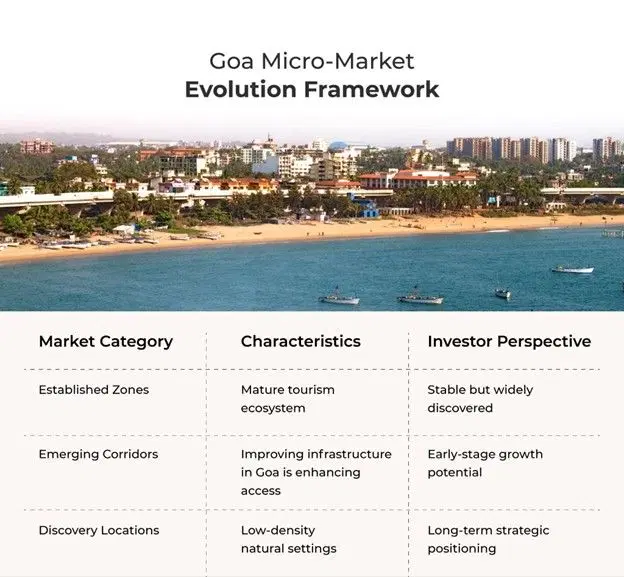
This framework explains why Goa real estate can no longer be analysed as a single unified market.
How Infrastructure in Goa is Reshaping Growth Corridors
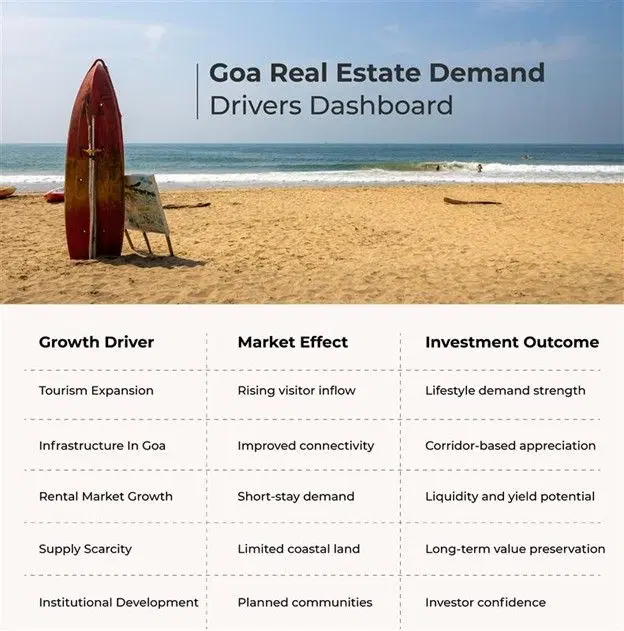
Infrastructure expansion is one of the most influential forces shaping Goa real estate today.
The operationalisation of Manohar International Airport at Mopa has significantly improved connectivity to North Goa and surrounding regions. Increased accessibility is expected to support tourism growth as well as investment interest in nearby areas. Industry coverage notes that the development of the Mopa airport has already begun influencing real estate activity in the surrounding regions.
These changes are altering how investors evaluate locations. Rather than focusing only on established tourist hubs, buyers increasingly assess:
- Proximity to airports and highways
- Access to tourism corridors
- Connectivity to lifestyle infrastructure
- Long-term development potential
As infrastructure in Goa strengthens, several previously overlooked areas are gradually entering the investment radar.
Tourism Growth Continues to Support Goa Real Estate
Tourism remains the backbone of Goa’s economic ecosystem. Goa witnessed a significant rise in tourist arrivals during early 2025, reinforcing its position as one of India’s most preferred leisure destinations.
This momentum contributes directly to ongoing Goa tourism development, which in turn strengthens long-term real estate demand.
For property markets, tourism functions as a powerful discovery mechanism. Many visitors who initially arrive for short holidays eventually explore ownership opportunities after repeated visits. This behavioural transition continues to reinforce demand across multiple segments of the Goa real estate.
Rental Markets Are Becoming a Market Indicator for Goa Real Estate
Another emerging signal of micro-market performance is rental activity. Short-stay rentals and extended lifestyle stays are increasingly providing insights into which locations have strong end-user demand.
Areas demonstrating consistent rental occupancy typically show:
- Strong lifestyle appeal
- Repeat visitor engagement
- Sustained investor interest
For buyers analysing real estate companies in Goa, rental activity often becomes an early indicator of which regions are transitioning from tourism destinations into residential ecosystems.
The Role of Planned Developments in Goa Real Estate
As the market evolves, a plotted development in Goa is increasingly assessed on factors such as clear documentation, organised infrastructure planning, accessibility, and surrounding development.
Projects by The House of Abhinandan Lodha in Goa focus on emerging growth corridors where tourism demand, improving infrastructure in Goa, and limited land supply converge. This alignment allows investors to participate in locations that are already positioned for long-term relevance.
For investors analysing Goa real estate, structured developments provide a clearer pathway to participate in the state’s long-term growth story.
Conclusion: The Smart Investor Studies the Corridor
The evolution of Goa real estate in 2026 reflects a shift toward micro-market intelligence.
Rather than evaluating Goa as a single destination, investors are increasingly studying infrastructure corridors, tourism flows, and emerging residential clusters.
Understanding these patterns allows buyers to identify locations where long-term value creation is already underway.
Explore thoughtfully planned land opportunities with The House of Abhinandan Lodha and discover how emerging corridors within the Goa real estate can support confident long-term investment decisions.
Related Blogs

Goa Beachfront: India’s Best Long-Term Investment Opportunity
30 Mar 2026

Mopa Effect: Why Now is the Best Time to Invest in Goa Real Estate
31 Mar 2026

Property for Sale in Goa: A Strategic Path to Long-Term Wealth Creation
30 Mar 2026