Ayodhya City 2.0: How it Affects Land Investment?
08 Jun 2026
Ayodhya city is undergoing a master-planned transformation driven by infrastructure, zoning, and long-term policy support. With airport expansion, hospitality demand, and large-scale public investment, real estate interest in Ayodhya is backed by clear fundamentals. Investors need to have a sound knowledge of which zones align with the city’s planned growth corridors rather than relying on proximity alone.
Ayodhya city is being built with a clear plan. If you are considering land investment, the real question is: where will value actually come from over the next decade?
The answer lies in the Ayodhya city development plan: zoning, infrastructure, and how different areas are being positioned. That’s exactly how you can spot a structured investment opportunity.
Let's break down the zoning frameworks, the infrastructure zones, and the precise corridors positioned for maximum returns in the Ayodhya City 2.0 development plan.
What is Ayodhya City 2.0?
Ayodhya City 2.0 refers to a policy-driven urban transformation, where growth is being directed through a structured development plan rather than organic expansion. At its core, the plan is built on five interconnected pillars:
- Spiritual tourism
- Hospitality infrastructure
- Mobility and connectivity
- Urban infrastructure
- Regulatory framework
What Does the Ayodhya City Development Plan Include?
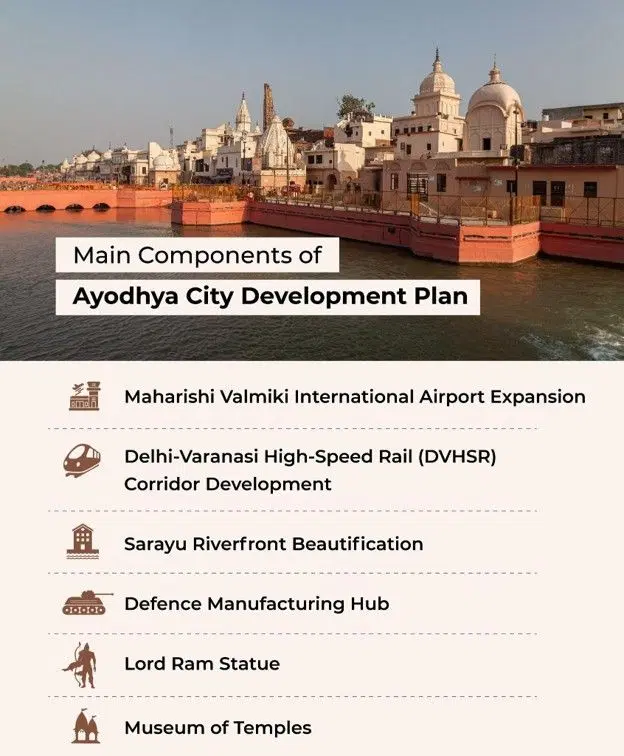
The official Ayodhya development plan is a Rs. 85,000 Crore blueprint that dictates exactly how the city will expand. It’s a multi-layered infrastructure and urban design framework with allocations for the following:
Global Connectivity Hubs
The Maharishi Valmiki International Airport is currently undergoing massive expansions to handle a future capacity of 60 lakh passengers annually. Simultaneously, the Delhi-Varanasi high-speed rail corridor will feature an Ayodhya spur, cutting travel time from the national capital to under two hours.
The Lifestyle Riverfront
A dedicated Rs. 2,000 Crore is being injected into the Sarayu Riverfront Beautification project. This will change traditional ghats into world-class spiritual promenades, complete with cruise tourism.
Economic Diversification
Beyond tourism, the region is preparing for a Rs. 75,000 Crore Defence Manufacturing Hub. This ensures job creation and a permanent residential demand base.
Cultural Megaprojects
To increase the length of tourist stays, the city is building a 251-meter-tall Ram Statue and a Rs. 750 Crore Temple Museum developed alongside Tata Sons.
Ayodhya City Development Plan: Where Will Value Be Created?
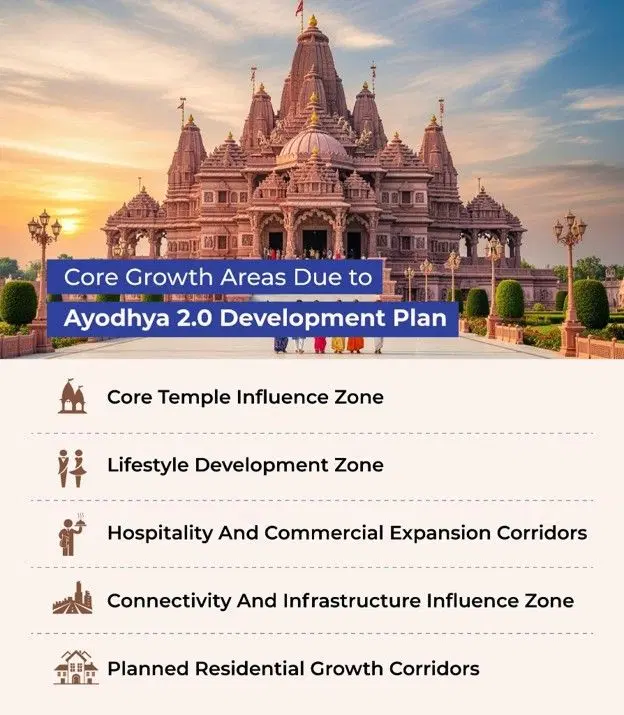
The most important part of the Ayodhya city development plan is zoning. This is what determines how land values will move over time. Have a look at some regions that attract real estate interest in Ayodhya:
1. Core Temple Influence Zone
Land in Ayodhya near Ram Mandir might be the first to see appreciation due to:) might be the first to see appreciation due to:
- Continuous visitor inflow driving year-round demand
- Strong potential for short-term rentals, retail, and hospitality
- Premium pricing due to proximity to key attractions
- Limited supply with consistently rising demand
2. Lifestyle Development Zone
The demand for an urban lifestyle corridor built around the Sarayu Riverfront and public spaces will also grow because of:
- Government-led beautification and infrastructure investment
- Higher preference for premium residential and hospitality projects
- Waterfront locations usually command long-term price premiums
3. Hospitality And Commercial Expansion Corridors
Market experts also forecast growth in land investments suitable for hotels, resorts, and organised commercial activity. It’s not hard to see why:
- Supply gap in quality accommodation creates pricing power
- Entry of branded operators signals institutional confidence
- High rental yield potential driven by tourism
4. Connectivity And Infrastructure Influence Zone
With the Ayodhya city development plan, areas aligned with the airport, highways, and major transit corridors will normally benefit. The reasons are:
- Improved accessibility increases land usability and demand
- Faster travel times expand the effective city boundary
- Early-stage pricing before full infrastructure completion
- Attracts both residential and commercial development
5. Planned Residential Growth Corridors
Newly developed residential zones created for long-term urban expansion are sure to see a surge in demand due to:
- Better planning, wider roads, and organised layouts
- Gradual appreciation as infrastructure expands outward
- Suitable for long-term holding and capital growth
Conclusion
Ayodhya city is being built through a long-term framework backed by infrastructure, policy, and sustained demand. And for potential investors who are thinking of land investment in the region, this completely changes the equation.
Timing is no longer the sole factor. You need to have a clear knowledge of the plan and positioning accordingly.
The House of Abhinandan Lodha offers a structured way to participate in this transformation. Get in touch with us now for more information!
FAQs
Is Ayodhya a good option for land investment?
Yes, Ayodhya is an exceptional land investment opportunity. The city is undergoing a massive infrastructure transformation, making early entry highly lucrative for investors securing master-planned plots.
What drives real estate interest in Ayodhya?
Global real estate interest in Ayodhya is fueled by a Rs. 85,000 Crore master-planned infrastructure pipeline that includes international airport expansion and high-speed rail connectivity.
How does zoning affect land value in Ayodhya city?
The Ayodhya city development plan utilises strict zoning that dictates exactly where land values will appreciate the fastest. Land within designated tourism, hospitality, and residential zones tends to appreciate faster than unplanned peripheral areas.
Why are institutional developers investing in Ayodhya?
Institutional developers recognise that Ayodhya development is backed by a decade-long government policy and massive capital deployment, rather than temporary sentiment.