Analysis of Ayodhya’s Real Estate Growth: 2020-Present
09 Jul 2026
From 2020 onwards, Ayodhya has seen a dramatic shift in its real estate story. The legendary city of Ramayana, home to many holy places of interest, is today becoming a real estate market in growth and development, fuelled by temple tourism, major infrastructure development, planned city growth, growth in the hotel industry and formal development of plotted properties.
It started developing as a real estate market during the 2020-2023 period. The year 2024 became a landmark year post the consecration of Ram Mandir. From 2025 onwards, it has moved into a more formalised phase when all the components of tourism, planning and infrastructure growth have become more visible in the form of growth in real estate.
2020-2022: The Base for Ayodhya’s Real Estate Growth
2020 was the year when the real estate market of the religious city Ayodhya was getting organised.
The early stages of growth were triggered by three major factors.
- The beginning of a larger temple-led transformation
- Government focus on city planning and infrastructure
- Rising attention from buyers, developers and local landowners
However, planning for Ayodhya development had begun around 2021-2022. An urban development presentation for Ayodhya was prepared by the Urban Planning Cell, SPMRI & HP, Ayodhya, in 2022. The Master Plan for the city was to be of 133 sq. km area, while the Ayodhya Development Authority area was of 873.37 sq. km. The presentation also mentioned a Greenfield Township covering 4.86 sq. km in the city. The presentation discussed the issues of increasing land prices and huge real estate development happening around the city and how to channelise this uncontrolled growth [1].
Growth in Ayodhya’s real estate market is not a post-2024 phenomenon. The early signs of growth were visible before the temple was inaugurated.
2023: Visitor Growth Started Strengthening the Market
In terms of numbers, 2023 was a bridge year for Ayodhya, since before the Ram Mandir had been completed and consecrated, 57.5 million visitors had come to the city [2].
This level of visitor movement started strengthening demand for:
- Hotels and guest houses
- Retail and food establishments
- Transportation
- Homestays
- Services for pilgrims
- Land adjacent to the access roads and corridors that were being developed
- Residential and Plotted development
For the real estate market, the number of visitors to a city is an important factor. This results in the development of roads, hotel space, shopping areas and demand for residential real estate.
Ayodhya’s growth is not only about people wanting to live in the city. Many buyers are also looking at it as a spiritual location where they can own property for long-term use, especially as visitor movement continues throughout the year.
Another guide worth reading is the temple tourism and property demand in Ayodhya, which tries to establish a correlation between visitor movements and real estate demand.
2024: The Turning Point After Ram Mandir Consecration
In 2024, Ayodhya rose several notches to become a significant part of the country’s real estate discussion. As the site of the Ram Mandir consecration in January 2024, the city began to generate huge numbers of visitors. While 57.5 million had visited Ayodhya in 2023, in 2024 the figure shot up to more than 160 million [2].
These changes affected the buyer’s interest in various ways:
- Ayodhya became an all-season destination for pilgrims and tourists
- Requirements for hotels and retail shops grew
- Land near key arteries became more sought after
- Plot comparisons began from the perspective of owning them long-term
- Larger projects were being evaluated by developers
There was growth in hotel and other local services in Ayodhya as well. As pointed out by a study conducted by IIM Lucknow, property prices in the city have increased by 25-40%. The study highlights various changes that have taken place in the city, including expansion of hospitality and local services around Ayodhya [3].
All properties in Ayodhya have not appreciated to the same extent or at the same rate. The study details the various parameters that would have a bearing on appreciation, such as location, accessibility by road, legal issues, development around the property and intended use.
2025: Tourism, Connectivity and Planning Became Stronger Growth Drivers
Estimated devotees visiting Ayodhya for the first six months of 2025 exceeded 230 million. The tourism economy of the city is growing annually from ₹8,000 crore to ₹12,500 crore and is likely to touch INR 18,000 crore by 2028 [2].
The figures provided are relevant as the growth of the city is fuelled by the larger economy of tourism, local commerce, transport, hotels and public infrastructure. Hence, the demand in real estate is not in isolation and is linked to these factors.
Increased Airport Connectivity has seen sharp growth in passenger movement numbers over the last two years. The numbers have grown from 2 lakh in Financial Year 2023-24 to over 11 lakh in Financial Year 2024-25 [4].
As connectivity improves, Ayodhya may become easier to access for tourists, families and long-distance buyers from different parts of India and abroad. Families will also be able to travel in and out of the city with greater ease.
Master Plan Expansion Is Widening Ayodhya’s Real Estate Map
The market for real estate in Ayodhya is shaped by the growing perimeter of the city as defined by the planning area of the Master Plan 2031. Phase 2 of the Master Plan for the city of Ayodhya, within the planning area of 873 sq. km, includes 343 villages from Ayodhya, Basti and Gonda districts, out of which 154 are from Ayodhya, 126 from Basti and 63 from Gonda [5].
The Master Plan has been formulated to develop facilities for residential, commercial and industrial purposes, and for providing public facilities. Thus, the Master Plan for Ayodhya is planned for creating a bigger urban area and developing Ayodhya as a tourist destination, not only around temples [5].
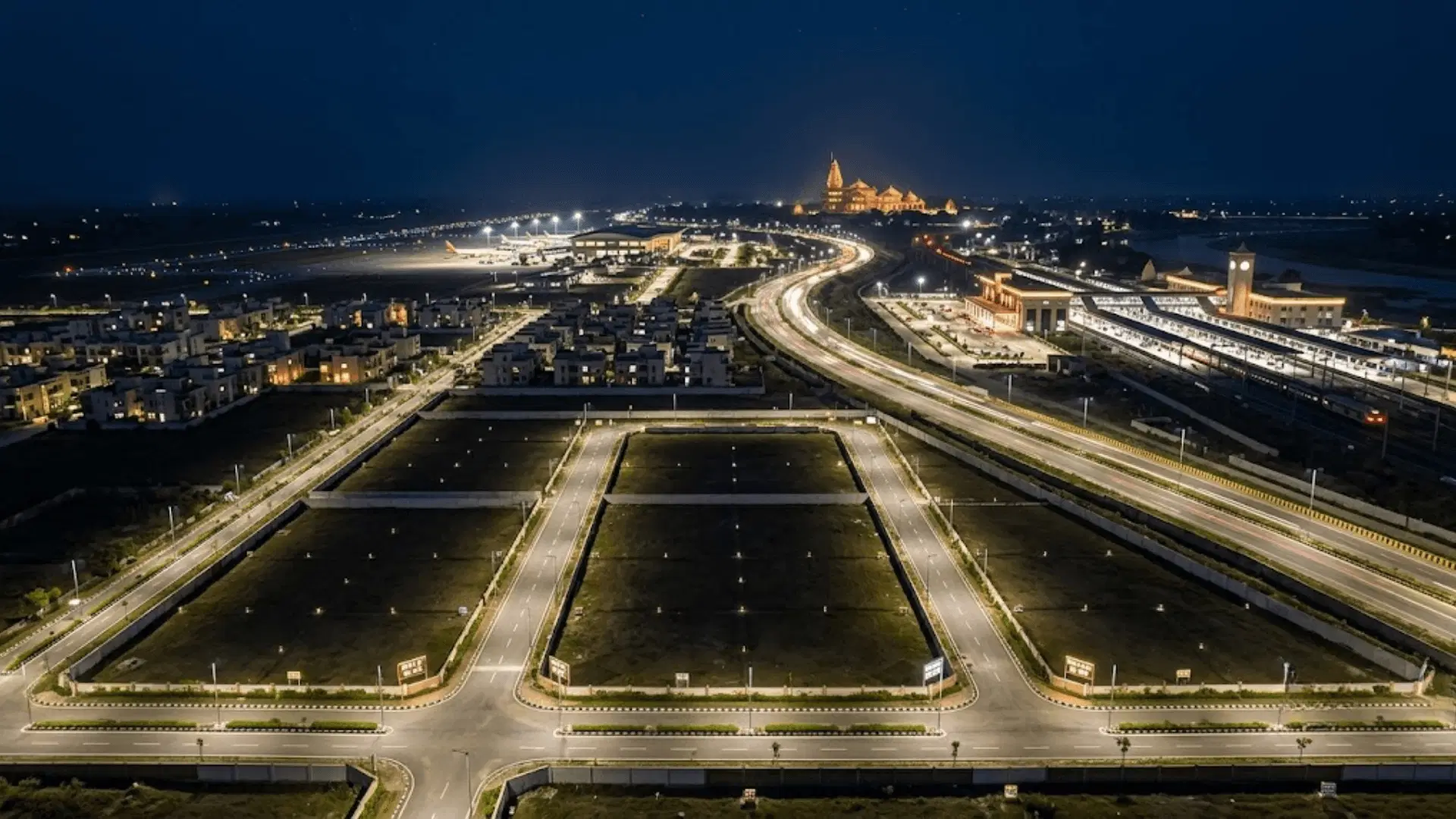
The New Ayodhya Township, also referred to as the Greenfield Township, is a 1,407-acre development located on both sides of the Lucknow-Gorakhpur highway [5]. This township may become a new hub for growth and may shift some focus from around the temple to other parts of the city.
As the market grows, formalisation of real estate becomes increasingly important for the buyer, who is looking beyond simple standalone land to purchase a portion of a well-planned, professionally laid out development with relevant amenities, formally registered with the relevant bodies.
Another such development underway is The Sarayu by The House of Abhinandan Lodha®, a housing project that has been registered with the regulatory authority [5]. HoABL Realtech Pvt Ltd is the developer behind the venture, created with The Leela in terms of the development format. It offers plots starting from 116 sq. meters, or approximately 1,248 sq. ft., and above, with 40+ amenities. Buyers must, as is the norm, verify all project-related documents, including RERA registration, possession timeline, project maintenance terms, etc., before making a purchase and also physically visit the property under development.
What the 2020-Present Growth Shows for Buyers
It has shifted from emotional buying to infrastructure-backed growth due to the development of infrastructure in the region.
Factors that drive the growth include:
- Pilgrimage demand driven by Ram Mandir project
- Movement of more visitors each year
- Development of hospitality and local business
- Airport connectivity development and road connectivity
- Expansion of Master Plan in wider planning area
- Inclusion of planned real estate projects
- Increased interest among families, NRIs and long-term buyers
As a buyer of Ayodhya plots, it would be wise to first understand the growth of Ayodhya and then start looking for a suitable property in Ayodhya. A growing city does not automatically translate into suitable opportunities for all plots of land. The buyer must first of all check for legal clearances, connectivity, approvals, basic amenities such as water and electricity, and most importantly, future utility of the land.
Why Buyers Should Avoid Only Looking at Price Growth
A higher price may attract buyer attention, but a lower price does not automatically mean that the land offer is too good to miss. The true value of any plot is in the location quality and the documents of that plot.
Read this guide to buying the right plot of land in Ayodhya if you are looking to buy a property and are wondering how to compare the prices of the plots to each other.
A low-priced plot may have limited value if it lacks access, has an unclear title, poor surrounding development and limited use. Even a higher-priced plot should be checked carefully if the buyer is not clear about the purpose of purchase.
Buyers need to compare the following:
- Location and entry road
- Distance from strategic routes and civic areas
- Zoning laws
- History of title
- Status of encumbrances
- RERA registration, where relevant
- Layout and approvals
- Utilities and surrounding development
- Terms of possession and maintenance
Conclusion
The early years of growth laid the foundation for the same, 2024 being the year when things started to change dramatically, and 2025 onwards being the phase when all this growth is getting formalised with an increase in tourism, airport usage, Master Plans and project registrations.
As a buyer, it would be wise to go through all the information required to make a careful purchase in Ayodhya. The city has spiritual value, a large number of visitors and growth in infrastructure. While the growth in real estate in Ayodhya is strong and worth studying, it is always advisable to verify the facts mentioned above to make a careful purchase.
A plot of land in Ayodhya carries meaning for a long time, so it is imperative to verify facts such as the exact location, all legal documents being in order, required sanctions and approvals from authorities, nearest distance to the main road, nearest basic utility services, how possession shall be given and future use of the land, and compare with other options before making a decision after verifying all facts.
FAQs
How has Ayodhya’s real estate market changed since 2020?
Ayodhya's real estate market has moved on from being a local faith-based market to a more planned real estate market. Temple development, tourism, connectivity, Master Plan and formal projects have commanded the attention of buyers since 2020.
Why did Ayodhya real estate growth accelerate after 2024?
The consecration of the Ram Mandir in January 2024 saw a sharp increase in footfall to the temple and generated huge interest in Ayodhya. This translated into demand for hotels, local amenities and transportation, retail spaces and properties in the city, thus increasing the visibility of real estate activities in the city.
What should buyers check before entering Ayodhya’s property market?
Before buying a property, one must check fundamental points such as title clarity, ownership history, necessary land-use permissions, approved plan, RERA registration if applicable, smooth road access, availability of basic utilities like water and electricity, possession terms, maintenance structure and surrounding developments.
Sources
https://www.awasbandhu.in/public/pdf/Presentations/Urban%20Development%20Projects%20in%20Ayodhya_Vishal%20Singh%20IAS.pdf https://invest.up.gov.in/wp-content/uploads/2025/11/6-Ayodhya_251125.pdf
https://invest.up.gov.in/wp-content/uploads/2025/05/1-Ayodhya_210625.pdf