How to Know the Perfect Time for Buying and Selling Land?
17 Aug 2026
Sometimes, buying and selling land at the right time can matter more than simply choosing the right location. The same piece of land can deliver very different returns depending on when an investor enters, how long they hold, and when they decide to exit.
So, most successful investors follow patterns. They watch infrastructure growth, track demand shifts, and understand where a destination sits in the broader real estate market cycle before making decisions.
That is why understanding real estate cycles matters. In this blog, we will explain how to make money by buying and selling land at the right time.
Different Real Estate Cycles: Which Stage Should You Choose for Buying and Selling Land?
Most land markets follow a recognisable growth pattern. The challenge is not only identifying a good location, but understanding where that location currently sits in its appreciation cycle.
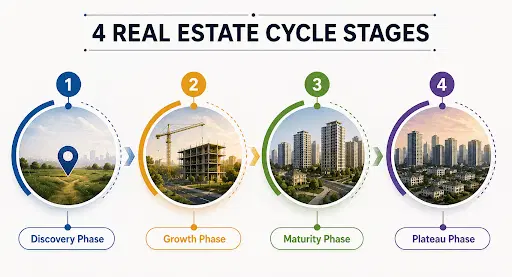
1. Discovery Phase: Highest Potential, Highest Uncertainty
The discovery phase is where a destination starts showing early signals of growth, but mainstream attention has not yet arrived.
At this stage, land prices are usually lower because awareness is limited. Investors who enter early often do so after identifying structural growth signals such as planned infrastructure, improving accessibility, or initial developer activity.
However, this phase also comes with higher uncertainty. Information for real estate investments can be limited, and predicting future demand requires stronger research and conviction.
Common signs of a discovery-phase real estate market include:
- Early infrastructure announcements
- Low buyer density
- Limited organised development
- Initial HNI interest
If you are an investor focused on buying and selling land for profit, this phase can offer the highest upside, but also requires patience.
Growth Phase: Smart Investor Window
The growth phase is where many informed investors prefer to enter.
At this stage, infrastructure execution becomes visible, demand starts increasing, and organised development activity improves confidence. The real estate market has already shown signs of validation, but appreciation potential still remains.
This phase usually includes:
- Better roads and accessibility
- Stronger developer participation
- Rising buyer enquiries
- Growing HNI and NRI activity
This stage creates the best balance between reduced risk and future upside for buying and selling land.
Markets experiencing infrastructure development and rising land demand often enter this phase before broader market awareness fully catches up.
Maturity Phase: Strong Stability, Slower Appreciation
The maturity phase begins once a destination becomes widely recognised.
By this stage, infrastructure has largely improved, buyer confidence is strong, and transaction activity becomes more stable. Demand often remains high, but pricing usually reflects the location’s growth story.
This means appreciation may continue, but not at the same pace seen during earlier phases.
Mature real estate markets often offer:
- Better liquidity
- More predictable demand
- Higher entry prices
- Slower appreciation velocity
For long-term real estate investment, mature destinations can still play an important role, especially if you are prioritising stability.
Plateau Phase: When Growth Starts Slowing
Not every market continues growing at the same pace forever.
A plateau phase occurs when appreciation starts slowing due to market saturation, high seller activity, or limited new demand.
Signs of a plateauing market may include:
- Too many competing projects
- Slower transaction velocity
- Rising resale inventory
- Flattening price movement
This stage often signals the right time to start exit planning in the cycle of buying and selling land.
How to Identify the Stage of a Real Estate Market?
Timing becomes easier when investors focus on measurable signals rather than market hype.
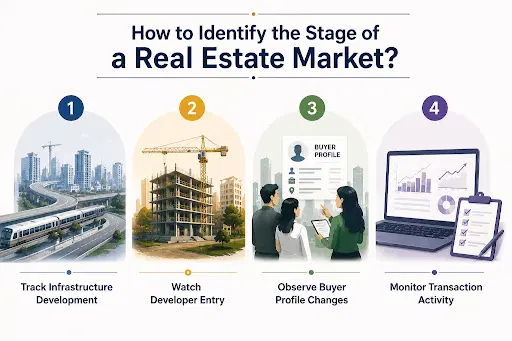
1. Track Infrastructure Development
Infrastructure is often one of the strongest indicators of future growth.
Road upgrades, rail connectivity, airports, commercial hubs, and infrastructure timelines that impact land valuation frequently shape future land demand. Historically, many emerging real estate investments have experienced stronger land value appreciation after accessibility improves.
2. Watch Developer Entry
The quality of incoming developers matters for buying and selling land. When organised developers begin entering a location, it often signals growing confidence in long-term demand.
3. Observe Buyer Profile Changes
Real estate markets tend to evolve when buyer quality changes.
Growing HNI and NRI participation, stronger end-user demand, and increasing semi-permanent living patterns often indicate that a destination is transitioning into a stronger growth phase.
4. Monitor Transaction Activity
Transaction velocity is also important. Faster deal closures, higher enquiry quality, and stronger resale activity often suggest rising market confidence.
When is the Best Time to Buy Land?
To master the perfect timing of buying and selling land for profit, your core strategy should be to buy during early organised growth rather than at the absolute peak of market hype. Even though the discovery phase offers deep discounts, the growth phase delivers a far more reliable balance of validated upside.
The fundamental rule of a successful real estate investment is simple: buy before the value of upcoming infrastructure projects becomes fully priced into the surrounding land. Entering an emerging destination when corporate developers begin structuring master-planned communities usually rewards investors with the cleanest, most secure path to wealth creation.
When is the Best Time to Sell Land?
Selling matters just as much as buying.
Many investors hold land too long and miss the strongest exit window. In many real estate investment cases, the ideal time to sell comes before full market maturity and before seller competition starts increasing.
Common exit signals include:
- Slowing appreciation
- Too many competing sellers
- Reduced transaction speed
- Market saturation signals
Conclusion
Strong returns from buying and selling land rarely happen by chance. Knowing exactly when to enter a growing market and when to execute a disciplined exit is what ultimately shapes your investment outcome.
Want to capitalise on the high-velocity growth windows before the real estate market reaches maturity? The House of Abhinandan Lodha® provides premium, legally secure, and master-planned land parcels across India's most lucrative corridors. Connect with us now for more information!
FAQs
What is the best time to buy land in India?
The best time to buy is during the early growth phase when key mega-infrastructure projects are physically visible but not yet fully priced into local land values. This offers the best balance of minimised risk and high appreciation runway.
How long should land usually be held for maximum returns from buying and selling land?
To capture the full compounding effect of infrastructure development, land should ideally be held for a mid-to-long-term horizon of 5 to 10 years, allowing the micro-market to fully transition from an emerging node to a mature destination.
How do I know if a land market is growing?
A growing market is marked by a sudden influx of Tier-1 branded developers, a rapid increase in transaction velocity, rising interest from HNI/NRI buyers, and visible upgrades to local roads and transit links.
When should investors sell land?
Investors should plan their exit just before the micro-market reaches full maturity. Exiting when transaction velocity is still high and before the secondary market becomes overcrowded with competing sellers ensures maximum returns and high liquidity.