Chhatikara Road, Sunrakh Road or Vrindavan Road: Which Belt Should Land Buyers Compare?
20 Aug 2026
Vrindavan real estate has moved beyond only temples, visitors, roads and planned development. A very important factor which is getting popular with buyers searching for land in Vrindavan is the location or the area within or outside the city.
Chhatikara Road, Sunrakh Road and Vrindavan Road are important roads that real estate buyers compare before making a purchase of land, as each of these has different characteristics to cater to different needs of buyers.
So, for a buyer searching for land for sale in Vrindavan, the important thing to note would be to first identify the goals of his or her search, his or her needs with respect to access to various parts of the city, his or her legal comfort level, and his or her long-term plans for the property he or she purchases.
Why Location Comparison Matters in Vrindavan
Vrindavan, in the Mathura-Vrindavan region of Mathura district in the state of Uttar Pradesh, India, is commonly known as part of the Braj region. Vrindavan is about 15 km from Mathura. Other locations in this Braj region are Govardhan, Barsana, Gokul, Nandgaon, Radhakund, Baldeo and Mahavan [1].
Buyers are interested in more than just a temple to visit. Parikrama, local roads, existing tourist trails, hotel options and, most importantly, access from Delhi-NCR can influence the location.
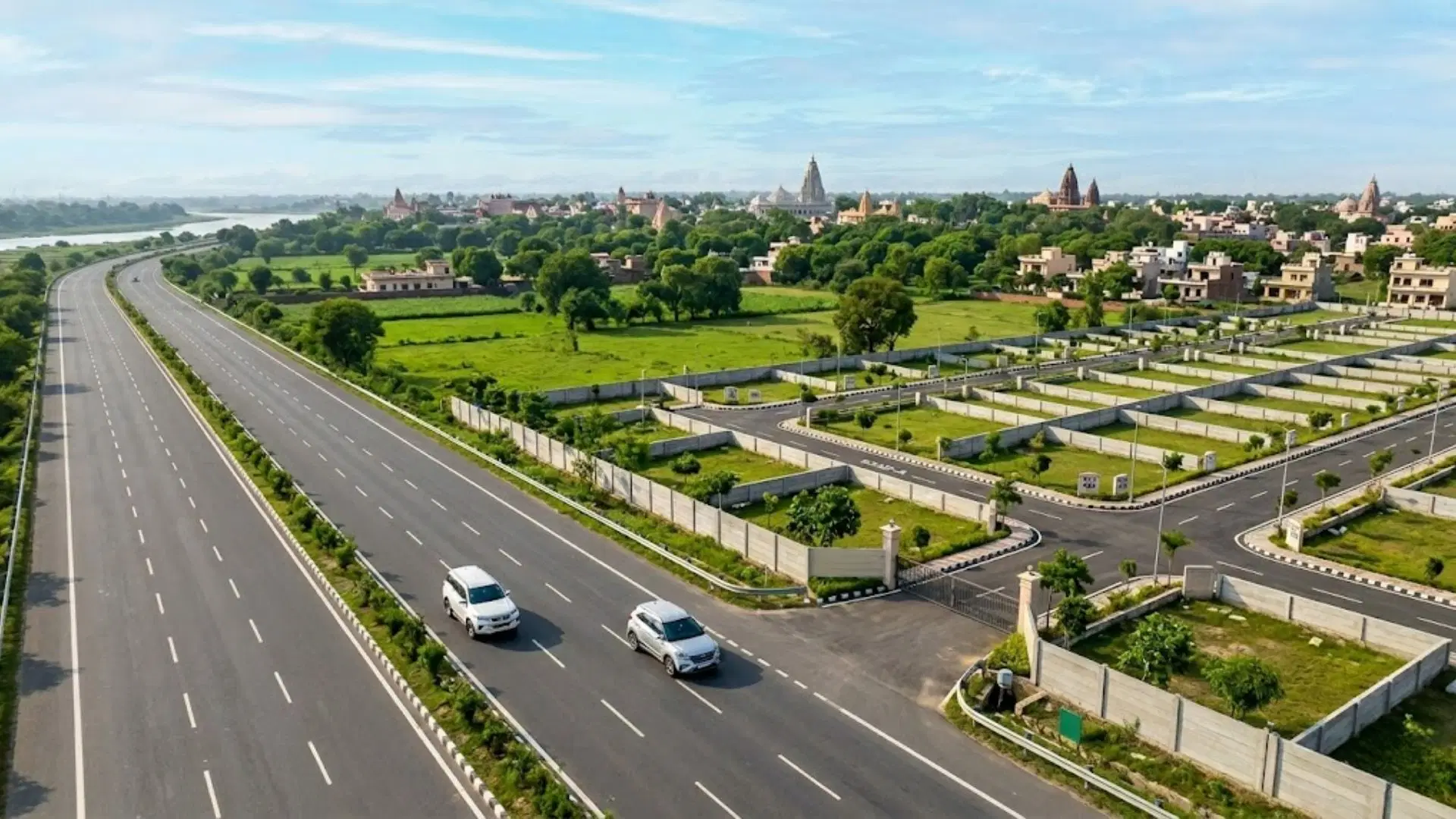
The Yamuna Expressway, 165.537 km with a 6-lane carriageway which can be extended to 8 lanes [2], is the main artery to access Mathura and Vrindavan from Delhi-NCR. The local roads of Mathura and Vrindavan would only be useful for buyers to compare and evaluate the usability of various locations within these towns.
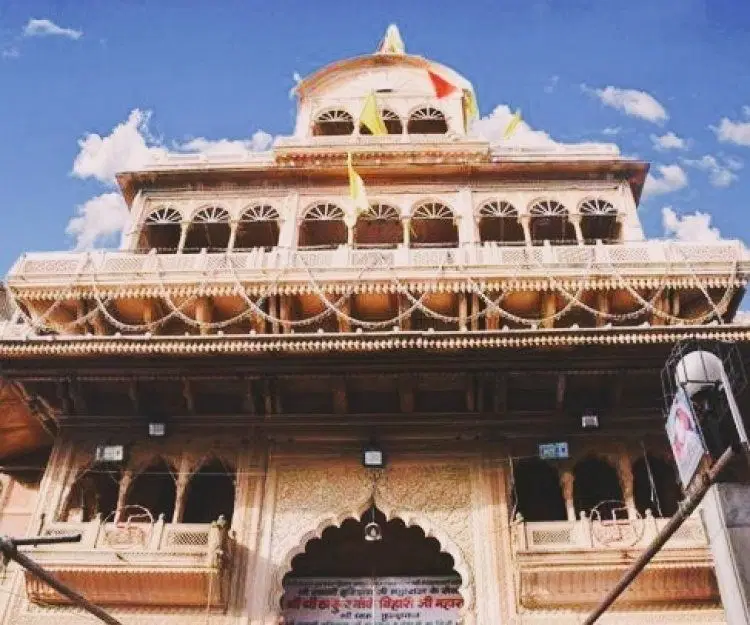
With growing crowds around the temples of the region, crowd pressure has become an important point to consider. In a recent hearing before the Supreme Court, the counsel for Banke Bihari Temple, a 1,200 sq. ft. property, submitted that daily visitors to the temple were around 40,000-50,000. This figure could increase to 1.5 lakh to 2 lakh on weekends and 5 lakh on festivals [3]. Thus, as a buyer, you should study the regions for access and usability rather than limiting yourself to places of religious significance.
Chhatikara Road: Stronger Entry Movement and Visitor Visibility
Chhatikara Road is one of the important approach-side roads for Vrindavan, as it has visibility, movement and relevance for the visitor economy.
There are developments taking place along this road as well. Recently, a plan worth ₹40 crore has been drawn up for the Chhatikara-Vrindavan Road makeover. This will include the installation of lampposts, illumination of building facades, two sculptures and a 10 km long green belt along this road [4].
For buyers, Chhatikara Road may be worth comparing if they are looking for:
- Better approach-side visibility
- Easier movement towards Vrindavan
- A location connected to tourist and pilgrim routes
- Access to hotels, local services and visitor-facing activity
- Long-term relevance as entry routes improve
However, buyers should also be careful. A highly trafficked route with a lot of people around can be negatively perceived by many families looking to purchase a plot of land and build a house for a peaceful way of life. They may not wish to be surrounded by traffic, lots of people and increased commercialisation.
Before shortlisting land here, buyers should check the width of the road, the current approach to the plot of land, traffic conditions, land use of adjacent plots, whether the road is due to be widened, whether there are any plans for beautification, and whether the plot of land under consideration is suitable for the intended use.
Sunrakh Road: Quieter Belt for Long-Term Planning
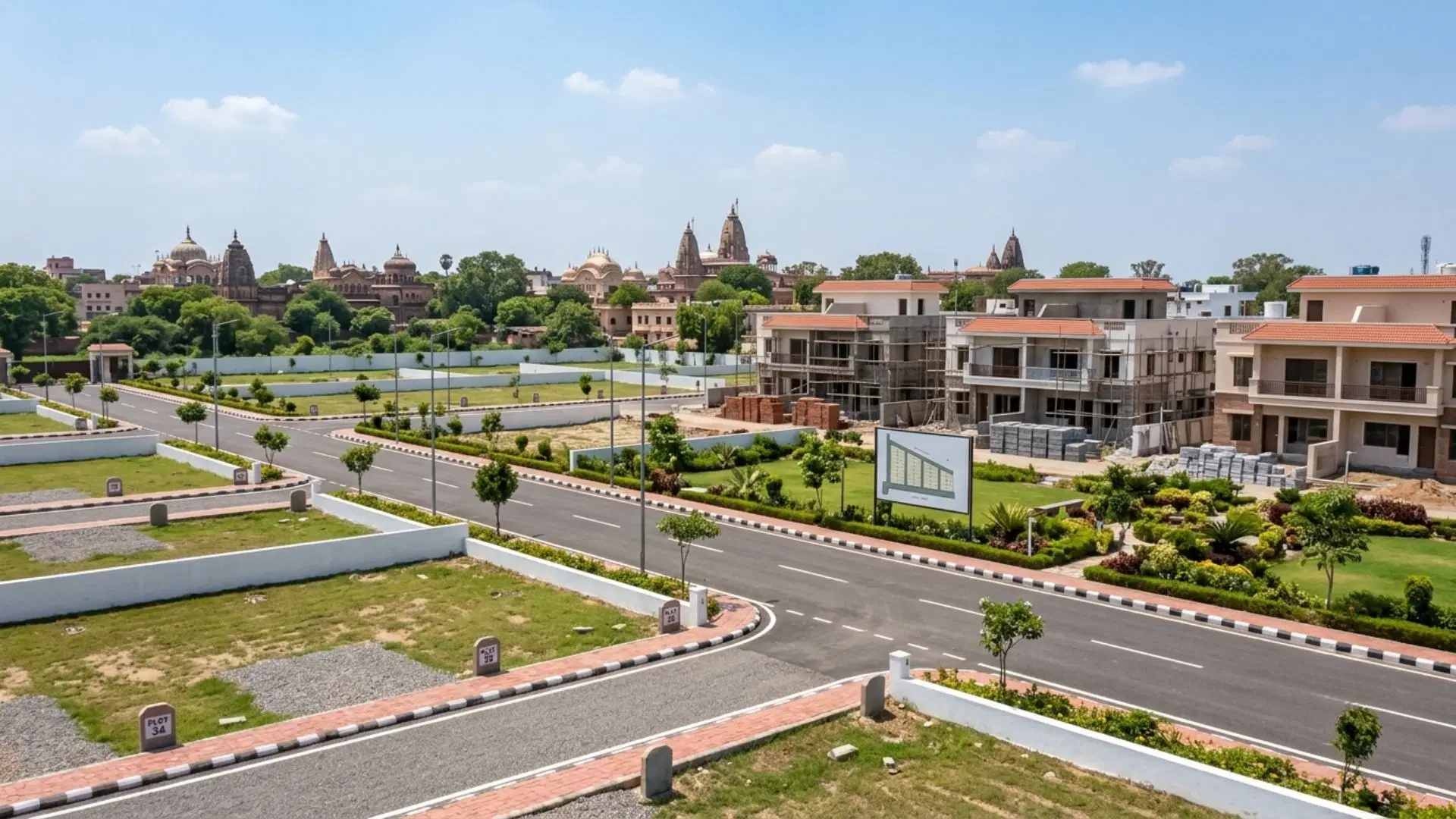
The plots on Sunrakh Road are perceived by buyers to be located in a quieter area than the temple-side plots and so may be of interest to buyers searching for a calm location or for development to be held long-term by a future family.
This location may be suitable for the buyer who does not want to be in the spiritual core of the area but at the same time wishes to be a part of the larger movement that is currently taking place in Vrindavan.
For buyers who have as a priority:
- A more serene environment
- Home planning for the future
- Long-term ownership
- More distance from crowded temples
- Comparing other plotted projects and large land holdings
- Access to Vrindavan without having to be in the most hectic inner streets
Just because a place seems quiet doesn’t mean it is better than other places. So, look into a few basic things: how does one reach the plot through the access road, is water supply and power supply available to the plot, is the plot surrounded by any development, and what is the legal status of the plot.
What seems peaceful at first might change during festivals, during monsoon and in peak tourist season.
Vrindavan Road: Check the Exact Stretch Before Comparing
“Vrindavan Road” is a term used extensively in property advertisements, but more so as a broad geographic location. It would be prudent for the buyer to clearly establish on which stretch of this road the plot is located. It may be on the axis of Vrindavan’s movement, on the Mathura side of Vrindavan or off a local access road in Vrindavan.
The location of Vrindavan Road is going to be of significance to the buyer who wants a location with a good balance of access to daily facilities and city connection. Thus, a plot on or off Vrindavan Road with proximity to transport points and city movement may be better than a plot in the interior of such a location.
Vrindavan Road could be a consideration for buyers interested in:
- Greater connectivity to the major city route
- Enhanced connectivity to the Mathura-Vrindavan circuit
- Greater practicality in daily use
- Proximity to amenities and transport facilities
- A site suitable for frequent visits
The value of plots on Vrindavan Road may vary greatly. It would first depend upon the seller referring to a specific stretch of Vrindavan Road. Also, the value would vary depending upon several other factors such as quality of road, current land use, congestion in the area, distance to various facilities, presence of basic utilities and overall development around that specific plot.
To understand more about why access has become such an important criterion in Vrindavan’s property market, please refer to the following guide: Why access is becoming a key factor in Vrindavan real estate.
Quick Comparison: Which Belt May Suit Which Buyer?
Planned Developments Buyers Can Consider in Vrindavan
Buyers may prefer to purchase a planned property as opposed to a standalone piece of land. Such a property may offer internal planning by the builder and access to various project amenities.
codename sez vrindavan by The House of Abhinandan Lodha® is a 65-acre development in Vrindavan. The project page lists 1 lakh+ sq. ft. of clubhouse arena, design inspiration drawn from the peacock and a sacred Anant Krishna Mandir within the project.
The Raas Villas by The House of Abhinandan Lodha is a limited-edition collection of 12 heritage villas developed at Vrindavan Global by The House of Abhinandan Lodha. The project details for The Raas Villas state that the villas have a size of 186 sq. meters, or approximately 2,002 sq. ft. The villas have been designed to represent the classic Indian villa aesthetic as heritage homes.
What Land Buyers Should Check Across All Three Belts
Whether the buyer is considering Chhatikara Road, Sunrakh Road or Vrindavan Road, the basic checks is important.
Purchasers should be sure to check the following:
- Title and history of ownership
- Classification of land use
- Approved layout or development plans
- Road access and rights of access
- RERA registration, where applicable
- Proximity to important routes and facilities
- Availability of water, electricity and drainage
- Monsoon access and road condition
- Nearby development and future usability
- Acquisition, widening or planning notifications
Visit the location at different times of the day, because Vrindavan looks very different on a normal weekday than on a weekend or on a festival, and then when all the temples are crowded with pilgrims.
Conclusion
There are three important corridors in Vrindavan: Chhatikara Road, Sunrakh Road and Vrindavan Road. All these corridors can be used for different purposes by different people. For a buyer looking at entry-side movement, Chhatikara Road may be suitable; for a buyer who wants to use the land in the future and wants a peaceful location, Sunrakh Road may be suitable; and for a buyer who wants a stronger route connection to use his land on a daily basis, Vrindavan Road may be suitable.
A buyer’s assessment of the different property belts will depend on his/her own objectives for buying a property, the extent of access that he/she requires, the documentation that may be required, currently ongoing development around the property and, last but not least, the buyer’s own long-term plan for the property.
FAQs
Which is better for land buyers: Chhatikara Road, Sunrakh Road or Vrindavan Road?
There is no one location stretch that’s best for every buyer. While Chhatikara Road may be suitable for entry-point movement and visibility, Sunrakh Road may be more suitable for a buyer who wants a calm environment to live in. Vrindavan Road may be more suitable for a buyer who wants stronger city and route connectivity. As always, it will depend on the purpose for which you’re buying, accessibility, legal clarity and how you intend to use the land in the future.
Why is Chhatikara Road important in Vrindavan real estate?
Chhatikara Road is significant because it is connected to Vrindavan’s approach-side movement. The stretch is seeing beautification-related attention, which includes provision of lighting, sculptures, facade improvement and a green belt on this road stretch. It is advisable to verify actual plot access and land use while shortlisting on this road for development.
What should buyers check before buying land in any Vrindavan belt?
A buyer needs to confirm title, ownership history, land use, approved development plan or master plan, plot connectivity and direct plot access. He should also find out about the width of the approach road, completed development around the plot, availability of basic services like power, water, sewerage, drainage, etc. He must also confirm whether the project is registered with RERA or not, where applicable, and confirm terms and conditions for possession.
Sources
https://uptourism.gov.in/en/page/mathura-vrindavan
https://api.sci.gov.in/supremecourt/2024/52096/52096_2024_8_1502_61936_Judgement_15-May-2025.pdf