How to Buy Land in India as an NRI Without Mistakes
17 Aug 2026
Buying land in India as an NRI can feel confusing at first. Rules around eligibility, documentation, payments, and registration are often different from what domestic buyers deal with. That’s why many buyers end up delaying the process altogether. So, how to buy land in India as an NRI?
The answer is simple: follow the process step by step. Start by understanding what kind of land an NRI can legally buy, then verify ownership and approvals, complete proper due diligence, and ensure FEMA-compliant payments.
In this blog, we will explain the procedure to be followed for the purchase of land in India by NRIs. These simple steps help you buy land with more clarity and confidence.
Steps-by-Step Guide for NRIs: How to Buy Land in India?
Check out the steps NRIs must follow for the purchase of land in India:
Step 1: Check the Type of Land
Before choosing any location or project, the first step is understanding legal eligibility. Under FEMA (Foreign Exchange Management Act) regulations, NRIs are allowed to buy residential and commercial properties in India without requiring prior RBI approval.
Yet, NRIs are generally not allowed to purchase agricultural land, plantation property, or farmhouses in India.
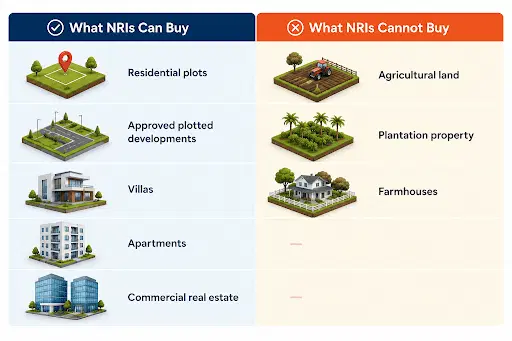
So, this is one of the most important things to consider before buying land in India. Always verify the legal classification of the land before making any payment.
Step 2: Finalise the Right Location and Developer
Many buyers focus only on pricing, but long-term land value depends heavily on future usability and development potential. So, you must check the following:
- Infrastructure growth
- Accessibility
- Planned connectivity
- Organised development
Locations with better infrastructure always perform better over time than isolated land parcels.
Developer credibility matters even more for NRIs because managing legal follow-ups from another country is difficult. You need to verify these as well:
- Developer’s track record
- Legal transparency
- Documentation support
- Project approvals
For many NRIs, organised developments feel safer for the purchase of land in India. The processes are more structured, and documentation is usually easier to manage.
Step 3: Conduct Legal Due Diligence Before the Purchase of Land in India
Legal due diligence is a critical part of legal land purchase in India and should always happen before paying booking amounts or token advances.
- Verify Title Ownership Start by confirming ownership. The seller should have a clear legal title and the right to sell the property. Reviewing the title chain helps identify ownership history and reduces the risk of disputes.
- Check the Encumbrance Certificate An Encumbrance Certificate confirms whether the land has existing legal liabilities such as unpaid loans, mortgages, or disputes. A clean certificate is one of the strongest indicators of legally clear ownership.
- Verify Land Use Classification Confirm whether the plot is residential, commercial, or agricultural. This is one of the most important things to consider before buying land in India because FEMA rules restrict certain land categories.
Step 4: Arrange FEMA-Compliant Payments
For NRIs, payments for the purchase of land in India must follow FEMA-compliant channels. Funds are typically remitted through NRE (Non-Resident External) or NRO (Non-Resident Ordinary) accounts.
You should use proper banking routes because documentation becomes important during:
- Taxation
- Repatriation
- Future resale
Strictly avoid informal transactions or unverified payment arrangements.
It is also important to understand applicable taxes and ensure transaction paperwork is properly documented.
Step 5: Prepare Registration and Documentation
Land registration in India is one of the most important stages of the land buying process in India.
NRIs can either travel to India for registration or appoint a trusted representative using a properly executed Power of Attorney (PoA). The PoA must usually be notarised and legally attested according to applicable requirements.
Keep all documents ready beforehand, including:
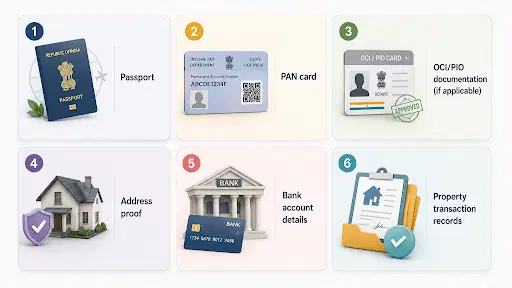
Many delays happen due to incomplete documentation rather than legal issues.
Can NRIs Buy Land in India, and What Are the Rules in 2026?
Yes. As of 2026, the core framework hasn't moved: NRIs can buy residential and commercial property in India under FEMA, 1999, without prior RBI approval. The restriction that trips people up is unchanged too: NRIs cannot buy agricultural land, plantation property, or farmhouses, whatever the budget or the plan to build later.
What stays fixed: the FEMA land-type restriction, routing payments through an NRE or NRO account, and needing a notarised, registered Power of Attorney if you're buying without traveling to India.
What to verify before you commit in 2026: RBI revises its Master Directions on foreign investment in immovable property from time to time, and individual states adjust stamp duty and RERA compliance requirements on their own schedule. Confirm your state's current stamp duty and the latest RBI Master Direction, available at rbi.org.in, before finalising anything. Don't rely on last year's numbers.
What hasn't changed: an NRI who inherits agricultural land can hold it but can only sell or gift it to a resident Indian citizen, and proceeds must go through an NRO account.
If a broker tells you a rule "changed for 2026" with no citation to an actual RBI circular or FEMA amendment, treat that as a sales tactic until you've verified it against the primary source yourself.
Regulations governing NRI property purchases are set by FEMA, RBI, and individual state governments, and can be amended. Confirm current requirements with a chartered accountant or property lawyer before proceeding.
Conclusion
till feeling doubtful about how to buy land? The purchase of land in India as an NRI is completely achievable when approached in the right order. You just need to understand the legal eligibility, verify the land classification, conduct the proper due diligence, and follow FEMA-compliant procedures to make the process far smoother.
If you are an NRI looking for a more structured and transparent buying experience, The House of Abhinandan Lodha® offers thoughtfully curated land opportunities backed by legal clarity, documentation support, and organised processes designed for modern buyers. Get in touch with us now for more information!
FAQs
How to buy land in India without visiting personally?
NRIs can complete the process without being physically present by appointing a trusted representative through a legally executed Power of Attorney (PoA). Proper notarisation and attestation are important to avoid registration delays.
Can I get a home loan in India as an NRI to buy land?
Yes, but major Indian banks and NBFCs only extend land loans to NRIs if the property is located within a RERA-approved, master-planned residential layout. The repayment tenure is usually shorter than a standard home loan.
What happens if an NRI inherits agricultural land in India but wants to sell it?
Even though you are legally permitted to hold inherited agricultural land under FEMA regulations, you cannot sell it directly to another NRI or foreigner. You can only sell or gift that specific agricultural parcel to a resident Indian citizen, and the sale proceeds must be routed into your NRO account.
Is an NRI required to file an income tax return in India after buying a property?
The purchase of land in India does not require you to file an Indian tax return. However, if that land eventually generates income, such as rental yield from a built villa or taxable capital gains upon resale, you are legally obligated to file an annual income tax return in India.
Can NRIs buy land in India, and what are the rules in 2026?
Yes. NRIs can buy residential and commercial property under FEMA, 1999, without prior RBI approval, but not agricultural land, plantation property, or farmhouses. Payments must route through an NRE or NRO account. The core framework is unchanged for 2026. Verify current stamp duty and the latest RBI Master Direction for your state before finalising a purchase.