Land Laws in Maharashtra: What Every Plot Buyer Should Know
17 Aug 2026
For many investors, the focus of a land purchase naturally centres on location, appreciation potential, and future development prospects. However, the long-term success of any land investment depends equally on understanding the legal framework that governs the asset.
Land laws in Maharashtra determine what can be built on a plot, how ownership is established, and whether the property can be used, developed, or transferred without future complications.
Understanding these regulations before signing any transaction helps investors protect capital and make more informed decisions.
Understanding the Legal Framework
Land ownership in Maharashtra is governed through a combination of state-specific land laws that address different aspects of land administration and development.
Among the most significant are:
- Maharashtra Land Revenue Code
- Maharashtra Regional and Town Planning Act
- Registration and Revenue Administration Laws
- Applicable Provisions Governing Plotted Developments
Together, these regulations shape ownership rights, land use, development permissions, and transaction procedures under the broader law of the land.
Why Land Use Classification Matters
One of the most important aspects of land laws in Maharashtra is land-use classification. Common classifications include:
- Agricultural land
- Non-Agricultural (NA) land
- Residential development land
- Commercial-use land
- Land located within Development Plan zones
Land-use classification determines its permissible uses, development rights, and approval requirements.
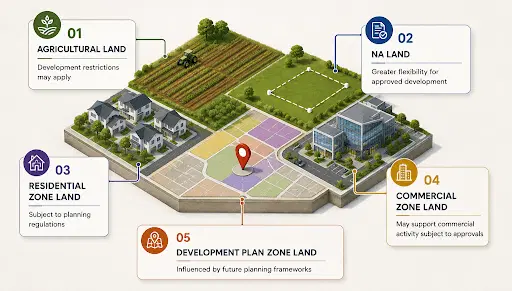
Understanding these distinctions is essential before committing to a purchase.
Why NA Conversion Status is Critical
Non-Agricultural (NA) conversion is the process through which agricultural land is legally approved for designated non-agricultural uses under applicable regulations. For buyers evaluating opportunities in destinations such as Alibaug, Neral, and other parts of coastal Maharashtra, NA conversion status is one of the most important verification points.
A plot classified as agricultural land may require formal conversion before certain forms of development can take place.
Investors should verify:
- Whether the NA conversion has been granted
- Whether approvals are complete
- Whether any conditions remain outstanding
- Whether land use aligns with the intended objectives
Title Verification Goes Beyond the 7/12 Extract
Many buyers assume that reviewing the 7/12 extract alone is sufficient.
In practice, comprehensive title verification involves a much broader review.
Important documents often include:
- 7/12 Extract
- Mutation records
- Encumbrance certificate
- Ownership history documents
- Revenue records
- Litigation checks, where applicable
Recent regulatory changes in Maharashtra have further streamlined aspects of land-use conversion and development approvals, reinforcing the importance of understanding a plot’s classification and regulatory status before acquisition.
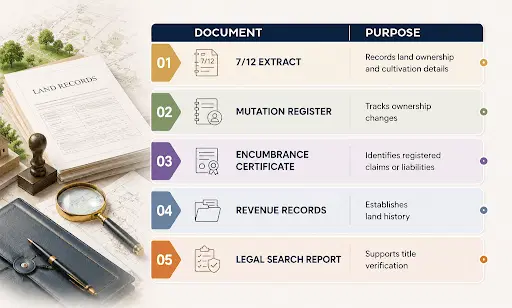
Reviewing these records helps reduce uncertainty and supports more informed decision-making.
How Property Laws Influence Investment Outcomes
Many investors view compliance as a procedural requirement. In reality, property laws in India directly influence investment outcomes.
Legal clarity can affect:
- Ease of future development
- Financing eligibility
- Transaction timelines
- Resale marketability
- Long-term ownership security
Why Legal Due Diligence Matters for HNIs and NRIs
For HNIs and NRIs, legal land purchase in India requires careful legal diligence, especially when investing remotely or across multiple markets.
It helps investors:
- Reduce acquisition risk
- Verify ownership integrity
- Understand development potential
- Avoid unforeseen regulatory complications
- Improve long-term investment confidence A disciplined legal review creates clarity before capital is committed.
A disciplined legal review creates clarity before capital is committed.
How Structured Developments Reduce Complexity
In fragmented land markets, independent legal verification can be extensive and time-consuming.
Structured developments help simplify this process through:
- Pre-verified title frameworks
- Legal diligence reviews
- Land-use compliance checks
- Better documentation standards
- Greater transaction transparency Developers such as The House of Abhinandan Lodha® undertake comprehensive legal due diligence before offering plots to buyers, helping investors enter transactions with greater clarity and confidence.
Conclusion
Land laws in Maharashtra are not merely administrative requirements. They form the legal foundation that determines whether a land investment is secure, usable, and capable of delivering long-term value. Investors who understand this framework before signing are better positioned to protect capital and make informed decisions.
FAQs
Q1. What is land law?
Land law refers to the legal framework governing ownership rights, land use, development permissions, transfers, and obligations associated with land.
Q2. What are the land laws in Maharashtra?
They are the regulations that govern land ownership, land use, development permissions, and property transfers within the state.
Q3. Why is land-use classification important?
It determines how a plot can be used and what approvals may be required for future development.
Q4. Why is NA conversion important?
NA conversion establishes whether land can be used for approved non-agricultural purposes under applicable regulations.
Q5. Is the 7/12 extract enough for title verification?
No. Comprehensive title verification typically includes mutation records, encumbrance certificates, ownership history, and additional legal reviews.
Q6. How do property laws in India affect investors?
They influence ownership security, development rights, transaction procedures, financing eligibility, and resale potential.