Land Valuation Explained: Securing Long-Term Investment Value
05 Jun 2026
Land valuation is the process of determining the financial worth of a land parcel based on location, legal clarity, infrastructure, and market dynamics. For HNIs and NRIs, it plays a critical role in transforming land from a physical asset into a measurable land investment. Professional valuation ensures that appreciation is real, defensible, and aligned with market conditions, enabling confident decision-making across buying, holding, and resale stages. It directly supports long-term returns by providing financial clarity at every stage of ownership.
For investors entering land markets, the initial focus is often on location and growth potential. However, the long-term success of any land investment depends on how accurately its value is understood, tracked, and validated over time. This is where land valuation becomes critical.
Unlike built assets, land does not always visibly reflect its value. Its true worth is defined by a combination of legal strength, accessibility, surrounding development, and future growth potential. Professional valuation brings structure to this assessment.
What is Market Valuation of Land, and Why Does it Matter?
The market valuation of land refers to the estimated price a land parcel can command under current market conditions.
This assessment considers:
- Legal clarity and title status
- Infrastructure and surrounding development
- Demand-supply dynamics
A structured valuation ensures that:
- The asset is priced realistically
- Investment decisions are based on data
- Future appreciation is measurable
How Does Land Valuation Support Long-Term Returns?
From a planning and investment perspective, valuation is not a one-time exercise. It is a continuous process that reflects how the asset evolves.
Professional land valuation supports long-term returns by:
- Establishing a clear entry value
- Tracking appreciation over time
- Aligning expectations with actual market performance
Over time, this ensures that growth is:
- Documented
- Justifiable
- Recognised by future buyers
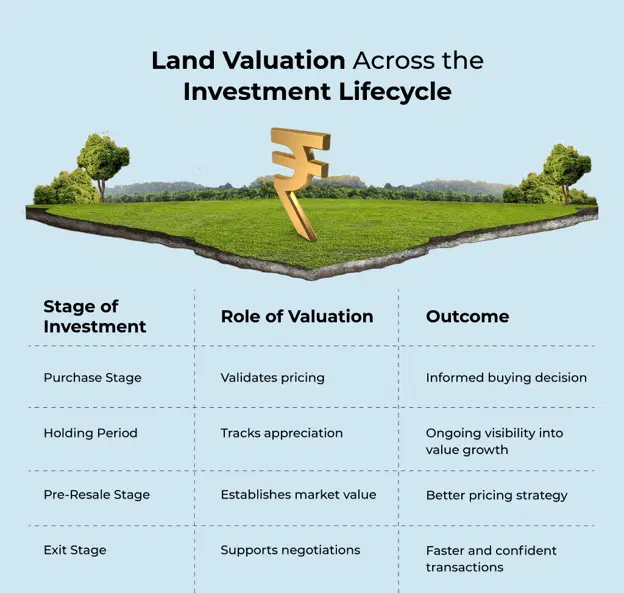
Stages Where Land Valuation Becomes Critical Land valuation plays an important role at multiple stages of ownership.
How to Check the Valuation of Land in India?
Understanding how to check the valuation of land helps investors stay informed and confident. Professional land valuation, typically conducted by qualified professionals, brings structure to this assessment.
Key methods include:
- Assessing infrastructure and development trends
- Consulting professionals
- Reviewing government circle rates
Additionally, verifying the land document is equally important, as legal clarity directly impacts valuation. These steps ensure that:
- The valuation is realistic
- Risks are identified early
- Investment decisions remain grounded
What Factors Influence Land Valuation the Most?
The value of land is shaped by multiple interconnected factors.
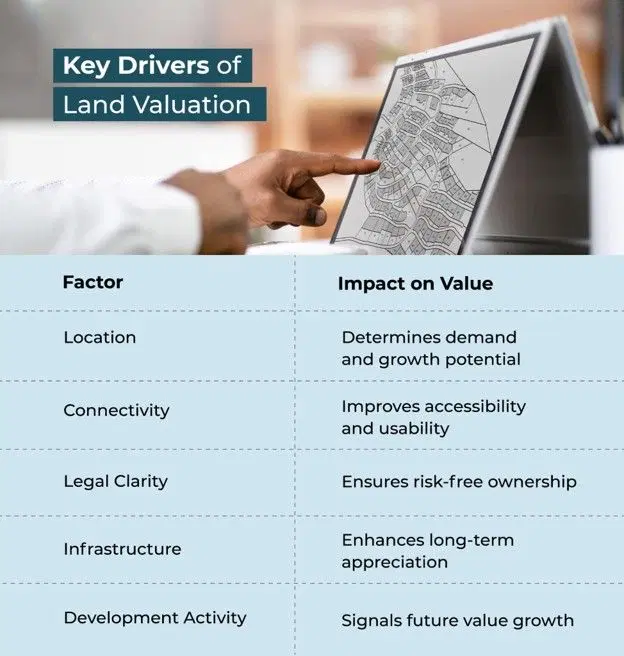
A strong combination of these factors results in:
- Stable valuation growth
- Higher buyer confidence
- Better resale outcomes
Why Professional Valuation Matters for HNIs and NRIs
For HNIs and NRIs, land ownership often spans geographies and time horizons. In such cases, land valuation becomes essential for maintaining financial clarity.
It enables:
- Objective assessment of asset performance
- Better portfolio management
- Confident decision-making across markets
How Structured Developments Strengthen Valuation Outcomes
In fragmented land markets, individual valuation can be complex. This is where structured developments add significant value.
Projects by The House of Abhinandan Lodha® are designed to support:
- Clear land titles
- Planned infrastructure
- Strategic location selection
This ensures that each land investment benefits from:
- Consistent appreciation patterns
- Strong resale positioning
Conclusion
Land valuation is the process that converts land into a financially measurable asset. It ensures that appreciation is clearly demonstrated. For investors building serious land portfolios, especially HNIs and NRIs, professional valuation is essential to secure long-term returns, guide decision-making, and maximise the potential of every land investment.
Projects by The House of Abhinandan Lodha® are structured to support this through strong legal frameworks, planned development, and strategic locations, ensuring that every land investment is positioned for measurable and sustainable long-term returns.
FAQs
Q1. What is land valuation?
Land valuation is the process of determining the financial worth of land based on market, legal, and physical factors.
Q2. What is the market valuation of land?
The market valuation of land is the estimated price it can achieve under current market conditions.
Q3. How to check the valuation of land in India?
It involves consulting professionals, and reviewing circle rates.
Q4. Why is land valuation important for investment?
It provides clarity on pricing, tracks appreciation, and supports strong long-term returns.
Q5. What documents affect land valuation?
A clear and verified land document significantly strengthens valuation by ensuring legal certainty.