What is Land Ceiling: Understanding Its Impact on High-Value Plots
08 Jun 2026
Land ceiling refers to the legal limits imposed on land ownership in India, a policy framework that continues to shape land availability and title structures. Introduced during the Indian Green Revolution, these laws aimed to regulate large landholdings and enable more equitable distribution. For modern investors, especially HNIs and NRIs, understanding ‘what is land ceiling’ is essential to assess title clarity, legal risk, and access to premium plots. This framework continues to influence the quality of land investments and the supply of large, legally clear parcels.
For many HNIs and NRIs building a land portfolio in India, the outlook often begins with location, appreciation, and long-term potential. However, understanding ‘what is land ceiling’ becomes quite important when evaluating the quality and legality of land as an investment.
What is the Land Ceiling Act, and Why Was It Introduced in India?
The origins of the Land Ceiling Act in India lie in the post-independence land distribution challenges.
At the time:
- Large tracts of agricultural land were concentrated in a few hands
- Policymakers aimed to create a more equitable distribution
- Agricultural productivity and land access became national priorities
The Land Ceiling Act of India aimed to:
- Cap the maximum landholding per individual or family
- Redistribute surplus land
- Promote more balanced development
In practice, landholding limits as per the Land Ceiling Act are not uniform across India. They vary based on factors such as land type, irrigation quality, and state-specific regulations. Fertile or well-irrigated land typically falls under stricter limits, while dry or less productive land may allow relatively larger holdings. While the intent was socio-economic, its long-term implications now extend into how land is structured and accessed for modern investment.
How Does the Land Ceiling in India Affect Today’s Land Ownership?
Today, land ceiling in India continues to shape ownership patterns in subtle yet important ways.
Decades of enforcement have resulted in:
- Fragmentation of large land parcels
- Distribution of ownership across multiple entities
- Layered ownership histories that require careful review
This pattern of fragmentation has been widely observed in India’s land systems and continues to influence both ownership structures and land availability. From a planning standpoint, once land gets fragmented, reversing that process requires significant coordination, time, and legal clarity, which directly impacts availability.
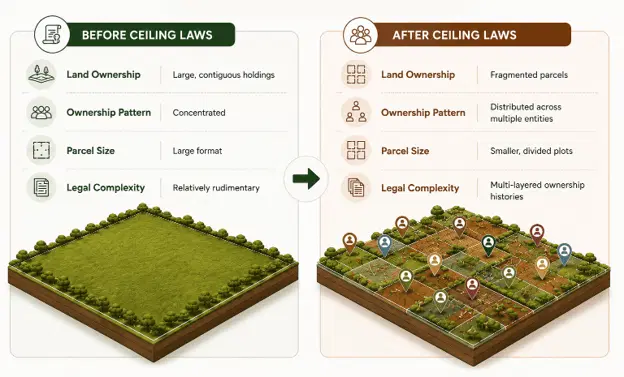
This directly explains the limited availability of large, legally clear land parcels in high-demand locations.
Why is Land Ceiling Important for Investment Decisions?
From an investor’s perspective, this concept is not just a policy reference. It directly relates to title clarity and long-term risk.
Plots that have passed through multiple ownership phases during the implementation of the Land Ceiling Act of India might:
- Carry unresolved legal claims
- Have incomplete or inconsistent documentation
- Require deeper due diligence
- Awareness of this context helps:
- Reduce legal uncertainty
- Improve confidence in investment
- Support stronger long-term returns
Why Premium Land Supply Remains Limited
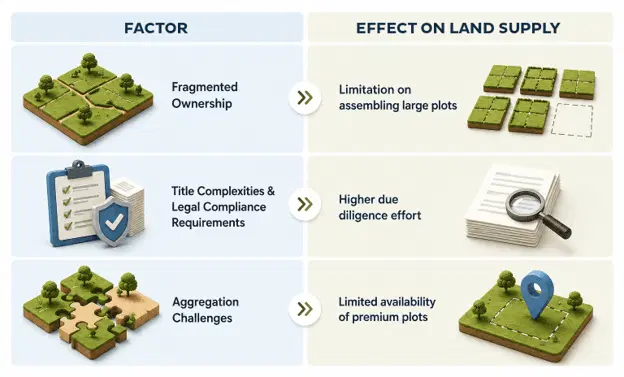
As a result, large, well-verified land parcels have become a relatively scarce asset class.
What Should NRIs Know About Land Ceiling in India?
For NRIs, understanding ‘what is land ceiling’ is particularly important when entering the Indian land market looking for long-term returns.
Key considerations include:
- Confirming compliance with applicable landholding norms
- Reviewing the title chain across past ownership phases
- Ensuring no unresolved legal issues linked to ceiling regulations
How Do Developer-Led Projects Address These Challenges?
Individually navigating land aggregation and legal verification can be complex in India, particularly in regions shaped by the land ceiling act.
Structured developments simplify this process by:
- Aggregating land across multiple ownerships
- Resolving historical title complexities
- Ensuring compliance with applicable land regulations
For buyers, this translates into:
- Access to legally verified land
- Reduced due diligence effort
- Greater confidence in the investment
Developers such as The House of Abhinandan Lodha® that operate within this framework enable access to land parcels that are both compliant and carefully structured.
Conclusion
Land ceiling is not just a policy concept; it is a structural factor that has shaped India’s land supply over decades. For investors, especially HNIs and NRIs, this understanding helps distinguish between straightforward opportunities and those that may carry hidden complexities. Clean, well-structured land parcels today represent a valuable category that supports strong long-term returns.
This is where structured developments play an important role. Projects by The House of Abhinandan Lodha® are structured to navigate these complexities through careful aggregation and legal diligence, enabling access to premium land parcels that support strong long-term returns.
FAQs
Q1. What is ‘Land Ceiling’?
Land ceiling’ refers to legal limits on the amount of land an individual or entity can own.
Q2. What is the Land Ceiling Act in India?
The Land Ceiling Act sets limits on landholding and governs the redistribution of surplus land.
Q3. How does Land ceiling in India affect investment?
Land ceiling in India influences ownership patterns, title clarity, and availability of large plots, impacting investment quality and long-term returns.
Q4. Are Land ceiling laws still relevant today?
Yes, their historical implementation continues to impact land ownership and transactions.
Q5. What risks are associated with the Land Ceiling Act in India?
Risks include unclear ownership history and potential legal complications if not properly verified.
Q6. How do developers manage land ceiling compliance?
Developers manage compliance by conducting legal due diligence, structuring land aggregation within permissible limits, and securing the required approvals under applicable land ceiling regulations.