Why Leisure is Driving Plot Development in Khopoli’s Weekend Economy
04 Mar 2026
On most Friday evenings, the Mumbai-Pune Expressway carries a familiar rhythm. Traffic thins after Panvel, the air cools near the ghats, and by the time Khopoli appears, the city begins to loosen its grip.
What often starts as a short escape tends to repeat itself. The same families return, the same routes are taken, familiar cafés, trails, waterfalls, and leisure parks begin to feel less like destinations and more like routine extensions. Over time, novelty gives way to familiarity, and this quietly reshapes how places are valued.
This is how many of India’s most liveable regions have evolved. Leisure arrived, livelihoods followed, and long-term settlements gradually shaped up. Goa followed this path decades ago. Khopoli now shows early signs of a similar transition, where the weekend economy is beginning to influence how land is being perceived, used, and valued.
With consistent weekend footfall, expressway access, and land parcels near leisure places, plot development in Khopoli is increasingly being shaped by repeat presence, usability, and long-term relevance.
Understanding Khopoli’s Weekend Economy
Weekend economy refers to locations where leisure travel generates recurring and predictable activity rather than seasonal (tourism) spikes. In such places, visitors return repeatedly, thus creating continuity instead of bursts.
Khopoli fits this pattern due to its position along the Mumbai-Pune travel corridor and its proximity to multiple leisure destinations. Research shows that regions located along major expressways with clustered attractions tend to witness higher repeat visitation rather than one-time tourism.
This steady inflow supports:
- Local employment and services
- Hospitality and short-stay formats
- Infrastructure upgrades
- Greater confidence in plot development
As weekend travel becomes habitual, land near these circuits is evaluated not only for escape value, but also for usability and continuity.
Leisure Anchors Driving Land Absorption
Large-format leisure anchors often act as stabilisers in emerging regions. They introduce predictable travel, encourage repeat behaviour, and keep locations active beyond seasonal peaks.
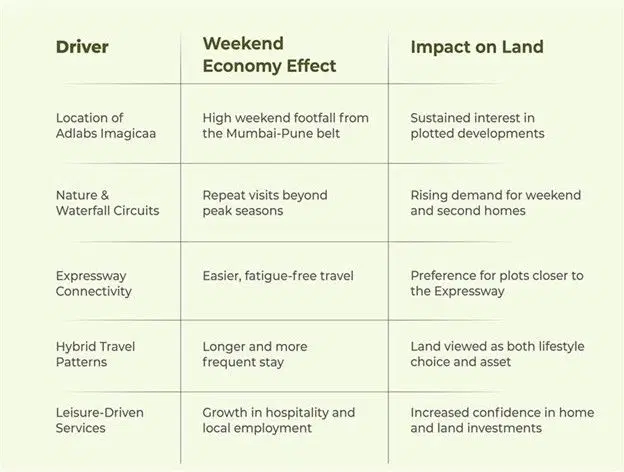
Located along the Mumbai-Pune Expressway, the Imagicaa location (theme park complex) has become one of the most recognisable leisure landmarks in the Khopoli belt. Its year-round operations and family-oriented appeal ensure consistent weekend movement from both Mumbai and Pune, reinforcing Khopoli’s position within the broader regional leisure circuit.
Beyond theme parks, Khopoli benefits immensely from:
- Trekking routes in the Sahyadri belt
- Monsoon waterfalls and nature trails
- Proximity to Karjat and Lonavala tourism zones
Land parcels near these leisure nodes demonstrate stronger demand as they support multiple uses like weekend homes, short-stay formats, and eventual residential planning.
How The Weekend Economy Influences Land Demand in Khopoli
Why Plot Developments Align with Leisure-Led Demand
In leisure-induced markets where buyers typically prefer flexibility over density, plotted formats outperform conventional housing. Industry research by ANAROCK indicates that plotted developments are increasingly favoured for lifestyle-driven locations due to the space, privacy, and design freedom that they provide.
Key advantages include:
- Freedom to build over time
- Open layouts suited to nature-oriented living
- Lower density aligned with weekend use
- Gradual capital deployment
For buyers considering home investments, plotted land allows participation in the weekend economy without immediate construction pressure.
Connectivity as the Silent Enabler
Leisure creates demand, but connectivity sustains it. Khopoli’s access via the Mumbai-Pune Expressway makes frequent weekend travel practical rather than exhausting. Ongoing infrastructure upgrades, such as the Expressway Missing Link, aim to further reduce travel time and improve safety. This ease of access supports the rise of dual-use patterns where land functions both as a retreat and a long-term asset.
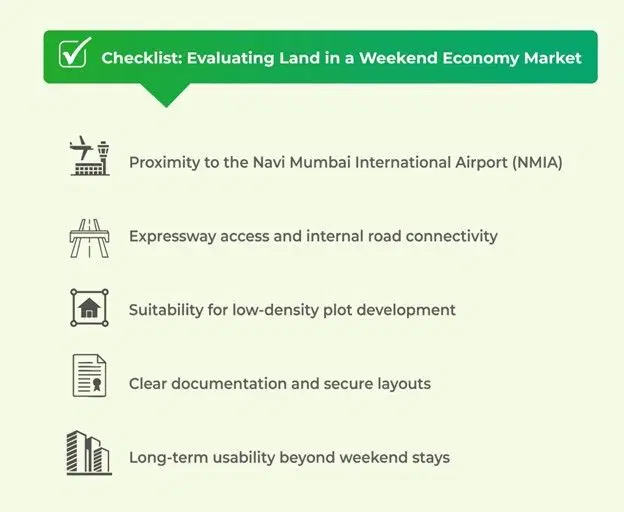
From Tourism to Settlement
Research published by MDPI Economies highlights that tourism-driven regions often evolve into residential ecosystems once repeat visitation stabilises and services mature. Khopoli appears to be entering this phase, where land is no longer seen purely as a getaway indulgence but as a place with future residential relevance.
How Developers Are Responding
As demand matures, structured developments become essential. Developers such as The House of Abhinandan Lodha are responding by creating gated community plots in Khopoli that align with leisure-led living while supporting long-term value creation. This approach bridges weekend usage today with settlement potential tomorrow.
Conclusion
Khopoli’s weekend economy is not just about tourism. It is slowly shaping where people want to buy land and how those areas garner value over time. When leisure spaces are supported by access and planning, they achieve long-term relevance.
For buyers exploring weekend homes, flexible home investments, or land aligned with evolving lifestyle patterns, Khopoli stands out as one of the most compelling land markets near Mumbai.
Related Blogs

Beyond the Congestion: Plots in Khopoli and the Story of Mumbai’s Expansion
19 Nov 2025

Buying Plots in Khopoli? Here’s How to Secure Clear Titles and Long-Term Value
07 Nov 2025
Land Investment Opportunities in Khopoli: The New Frontier for Resorts and Holiday Homes
22 Jul 2025