How Land Reforms in India Shape Modern-Day Investment
14 Aug 2026
For serious investors, land ownership in India is shaped not only by location and market demand but also by the regulatory history that governs how land can be held, used, transferred, and developed.
Understanding land reforms in India helps place today’s land transactions within that broader legal framework. In practice, many of the risks and opportunities associated with land investment emerge not from visible market conditions alone but from the legal structure beneath them.
When Did Land Reform Start in India
The answer to when land reform started in India lies in the years immediately after independence.
The early phase of land reform focused on correcting highly unequal ownership structures inherited from colonial-era agrarian systems. The first major measures included:
- Abolition of zamindari and intermediary ownership systems
- Regulation of tenancy rights
- Redistribution of surplus land through ceiling laws
- Efforts to improve access to productive land for cultivators
The objectives of land reforms in India were therefore social as well as economic, including reducing the concentration of ownership, improving agricultural productivity, and creating a more balanced landholding structure.
What Are Land Reforms in India Today?
For modern investors, the relevant aspect of land reforms in India is not historical but the continuing regulatory evolution that affects present-day transactions. Today, the most active dimensions include:
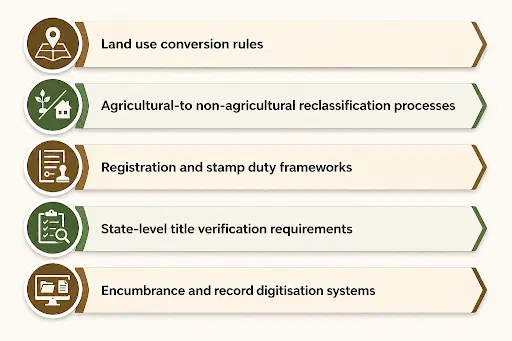
- Land use conversion rules
- Agricultural-to-non-agricultural reclassification processes
- Registration and stamp duty frameworks
- State-level title verification requirements
- Encumbrance and record digitisation systems
These factors influence the cost, timing, compliance burden, and practical viability of a land investment.
Why State-Level Regulation Matters
Unlike many asset classes, land regulation in India remains significantly state-driven. This means that investment conditions may differ across states based on:
- Land conversion procedures
- Documentation standards
- Approval timelines
- Registration frameworks
- Use restrictions applicable to specific land categories
As a result, identical-looking plots across different states may carry very different regulatory implications.
How Land Reforms Have Improved Transparency
One of the most important developments over the past decade has been greater transparency in land administration. Several Indian states have introduced:
- Digital land records
- Online title verification systems
- Better access to mutation records
- Clearer encumbrance certificate frameworks
These measures have reduced information asymmetry that historically made land transactions more opaque for buyers without local knowledge.
Recent reporting by The Economic Times and Business Standard has also highlighted growing emphasis on digitisation, stronger registration systems, and more transparent land governance.
How Land Reform Affects Investment Decisions For investors, the regulatory structure directly affects practical investment outcomes.
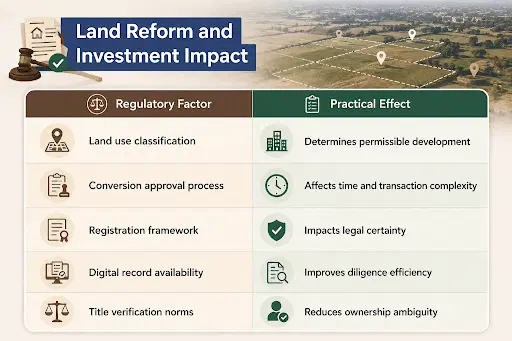
A plot with clear legal positioning often carries lower execution risk and stronger long-term liquidity.
Land Reforms Act in India and Current Relevance
The phrase land reforms act in India is often used broadly, but in practice, land reform is not defined by a single national statute. Rather, it reflects a layered framework of:
- State-specific land ceiling laws
- Tenancy regulations
- Conversion norms
- Registration laws
- Revenue administration procedures
For modern land investors, understanding this layered structure is more useful than focusing on a single historical legislative reference.
Why This Matters for HNIs and NRIs
For HNIs and NRIs building land portfolios across geographies, regulatory awareness becomes especially important. It helps investors:
- Assess compliance risk before acquisition
- Understand transaction timelines more accurately
- Evaluate legal readiness for future development
- Improve confidence during exit or resale
In practical terms, regulation influences not only acquisition quality but also how smoothly capital can later be realised.
How Structured Developments Reduce Regulatory Complexity
In fragmented land markets, legal land purchase in India requires substantial independent legal diligence. Structured developments simplify this process through:
- Pre-verified title frameworks
- Land use compliance checks
- Aggregated legal documentation
- Better-defined regulatory positioning
Developers such as The House of Abhinandan Lodha® operate within this framework, helping investors participate in growth markets while reducing exposure to historical legal complications often associated with unstructured acquisitions.
Conclusion
In land investment, regulatory understanding is not optional. While India’s land reform history is complex, the present direction is increasingly aligned with greater transparency, clearer land-use frameworks, stronger title discipline, and more structured buyer protections.
For HNIs and NRIs, this means that investment quality increasingly depends not only on location but also on its compliance readiness. Projects by The House of Abhinandan Lodha® are positioned within this framework through legal diligence, planned development, and stronger regulatory alignment, helping investors access land opportunities with greater clarity and confidence.
FAQs
Q1. What are land reforms in India?
It refers to the legal and policy framework governing land ownership, land use, transfer, tenancy, and related regulatory structures.
Q2. When did land reform start in India?
Land reform began in the years immediately after independence, with the abolition of zamindari and tenancy reforms.
Q3. What are the objectives of land reforms in India?
The objectives included reducing ownership concentration, improving access to land, and increasing agricultural productivity.
Q4. Are land reforms still relevant today?
Yes. Modern land reform continues through land use conversion, title digitisation, registration systems, and state-level regulation.
Q5. Why do land reforms matter for investors?
They affect title clarity, compliance burden, transaction timelines, and long-term investment security.
Q6. How do structured developments help?
They reduce legal uncertainty by providing pre-verified title frameworks, regulatory diligence, and better-defined land positioning.