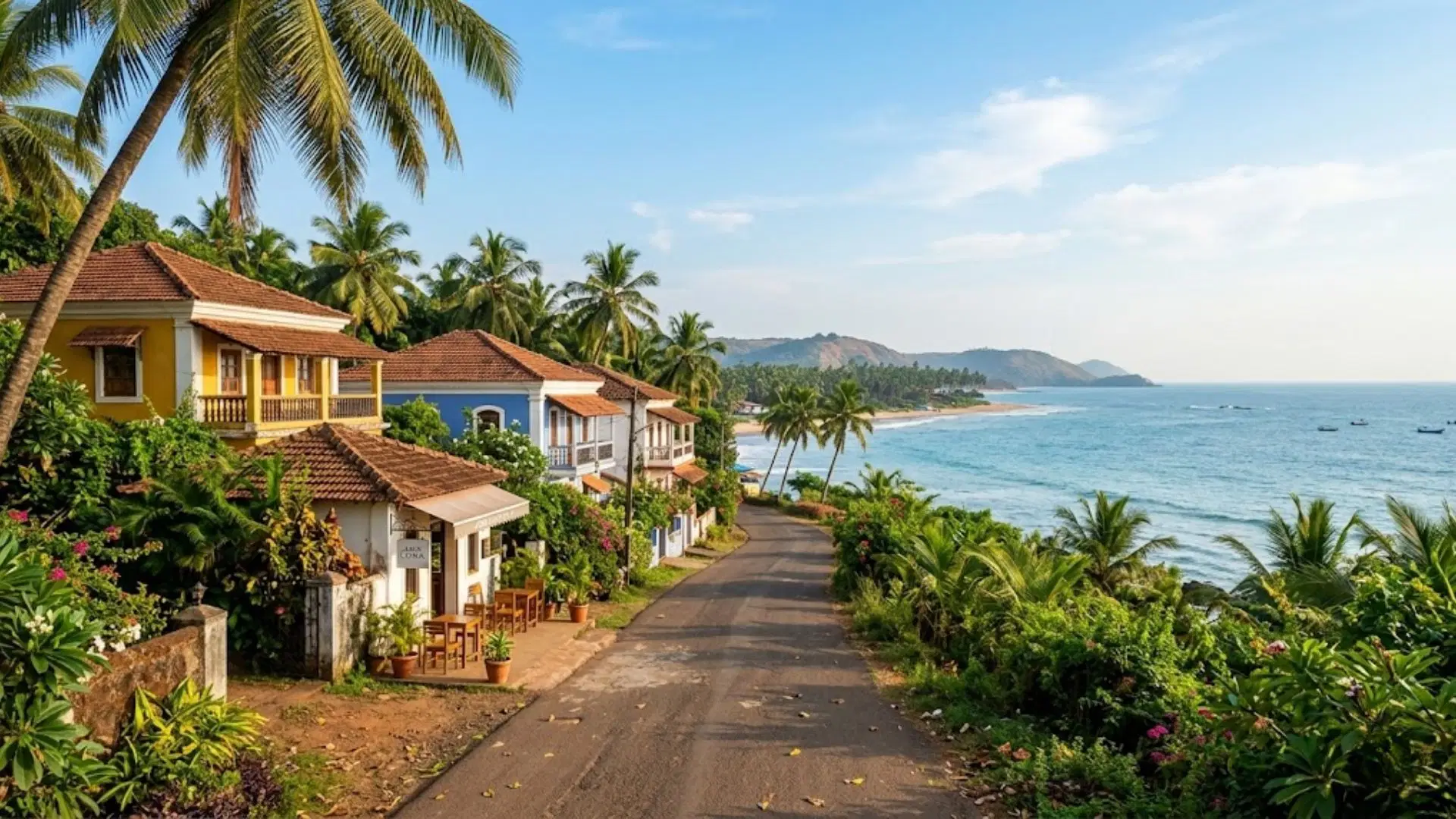
Top Plotted Development Projects Near Goa for Investment in 2026
28 Sep 2026
Goa’s plotted development market has moved beyond its earlier image of standalone beach houses and locally sold parcels. Buyers can now find gated plot communities, villa plots, resort-led developments and larger master-planned townships across established coastal locations and emerging inland corridors.
Manohar International Airport at Mopa is an important part of this change. Operational since 2023, the airport handled more than five million passengers and served over 35 destinations during FY 2025–26. Goa also recorded approximately 1.08 crore tourist arrivals in 2025, supporting continued demand for hospitality, second homes and lifestyle-oriented real estate [1].
The difficulty for buyers is not finding projects. It is distinguishing a well-planned development from one supported mainly by location claims, renders and future promises.
For anyone considering Goa for investment in 2026, a “top project” should not simply mean the most expensive or heavily advertised option. It should mean a development with independently verifiable registration, clear land records, realistic timelines, actual infrastructure progress and a location supported by durable demand.
What Does a “Top” Plotted Development Actually Mean?
The word “premium” is widely used in Goa’s property market. It may describe a sea-facing location, a private pool, a resort concept or simply a higher price.
None of these factors independently establishes investment quality.
A serious plotted development should be evaluated through five fundamentals.
1. Verifiable RERA Registration
The registration number should be checked directly on the Goa Real Estate Regulatory Authority portal. The record can help buyers verify the promoter, project type, survey number, registered land area, development timeline and documents uploaded for the specific project or phase. Goa RERA maintains public project records and separate lists for withdrawn, cancelled and rejected registrations.
Where a project is being developed in phases, each registered phase may be treated as a separate real estate project under RERA. Buyers should therefore confirm that the registration number shown in the brochure applies to the exact phase and plot they are purchasing.
2. A Documented Master Plan
A master plan should show more than plot divisions and conceptual amenities. Buyers should understand:
- What infrastructure belongs to the registered phase
- Which amenities are confirmed
- What will be developed later
- Whether different components require separate approvals
- When roads, utilities and community spaces are scheduled for completion
A project can be large overall while the buyer’s plot falls within only one registered phase. The agreement and RERA record should therefore be compared with the broader marketing plan.
3. A Credible Development Timeline
“Under development” is not a possession date.
A credible project should provide a stated completion schedule and measurable milestones. For plotted developments, buyers should check the latest progress disclosures, development certificates and any extension granted by the regulator.
They should also distinguish between plot handover, completion of internal infrastructure and completion of the entire township. These dates may not always be the same.
4. Clear Land and Access Rights
A well-marketed plot can still face problems if the title, subdivision approval, land use or access road is unclear.
The buyer’s lawyer should examine the survey number, title chain, encumbrances, approved layout, conversion sanad where applicable and rights over the approach road. RERA requires promoters to submit information relating to legal title and encumbrances, but independent verification remains necessary.
5. Connectivity That Exists on the Ground
“Minutes from Mopa Airport” can mean different things depending on the actual road, traffic and route used.
Buyers should test travel time themselves and distinguish between operational infrastructure, work under construction and future proposals. A confirmed road connection carries more weight than an infrastructure announcement with no clear execution timeline.
The basic principle is simple: a top development is defined by what can be documented and inspected, not by what looks attractive in the brochure.
Why North Goa Is the Centre of Investment Activity in 2026
North Goa continues to receive substantial investor attention because several demand and infrastructure drivers are concentrated in the region.
Manohar International Airport has widened access to the northern part of the state. Its current annual passenger capacity is reported at 7.7 million, with domestic and international connectivity continuing to develop [2].
Road infrastructure is also changing. Work on the six-lane elevated corridor at Porvorim continued through 2026 and had entered its final stages by late July. This corridor is intended to address congestion on an important NH-66 stretch connecting Panaji with the wider North Goa region [3].
These developments matter because North Goa’s real estate demand is not dependent on a single buyer category. It includes:
- Second-home purchasers
- HNIs and NRI buyers
- Hospitality operators
- Lifestyle migrants
- Holiday-rental investors
- Buyers seeking future villa construction
- Long-term land investors
Tourism demand also continues beyond the traditional peak season. Goa Tourism reported 10.8 million visitors during 2025, including more than half a million international visitors [4].
However, airport and tourism growth should not be interpreted as a guarantee that all plotted development projects in Goa will appreciate.
Goa Corridors and Micro-Markets to Evaluate
Rather than ranking individual projects, buyers can divide the market into corridors with different strengths, entry costs and holding periods.
1. Mopa–Pernem Growth Corridor
Pernem receives the most direct airport influence because Manohar International Airport is located at Mopa within the taluka.
The corridor may appeal to buyers looking for:
- Airport-linked accessibility
- Hospitality and service-sector growth
- Connections towards Maharashtra
- Emerging commercial activity
- A longer infrastructure-led investment horizon
The main risk is paying an airport premium for land that still lacks strong last-mile access, approved residential use or surrounding development.
A plot’s straight-line distance from the airport is less important than its legal usability and road connection.
2. Bicholim and the Eastern North Goa Belt
Bicholim is attracting attention for larger plotted developments that may not be possible in Goa’s more densely developed coastal villages.
Its investment proposition is different from Assagao or Morjim. Bicholim offers an inland setting connected to the wider North Goa and Mopa-linked region, with more scope for large, contiguous master planning.
This can support developments with:
- Larger community infrastructure
- Clubhouses and recreational spaces
- Defined internal road networks
- Resort or hospitality components
- Multiple development phases
Buyers should still verify whether an advertised township is being developed under one registration or several phase-wise registrations. They should also assess actual travel time to the airport, beaches, Panaji and everyday services.
3. Assagao, Siolim, Morjim and Established Lifestyle Markets
These locations already have a strong identity within North Goa’s villa, hospitality and second-home market.
Their advantages include established restaurants, boutique stays, rental demand and buyer familiarity. However, these strengths are often reflected in the entry price.
For investors searching for the best plots near Goa’s most recognised lifestyle destinations, the central question is no longer whether the area is desirable. It is whether the specific plot remains reasonably priced after years of appreciation.
Fragmented ownership, narrow village roads, zoning restrictions and limited plot availability can also make due diligence more complex.
4. Porvorim and the Panaji-Connected Belt
Porvorim appeals to buyers who prefer access to Panaji, established social infrastructure and year-round residential activity rather than a purely holiday-focused market.
The ongoing elevated corridor is expected to improve movement through a historically congested stretch once operational.
This corridor may suit buyers looking for a balance between urban convenience and access to North Goa. However, it generally offers a different product from large greenfield plotted townships because land parcels are often smaller and the surrounding development is more established.
5. South Goa’s Lower-Density Markets
South Goa may appeal to buyers prioritising privacy, lower-density surroundings and a quieter lifestyle.
It does not have the same direct Mopa-led narrative as North Goa, but it benefits from established beaches, Dabolim Airport, tourism and access towards Karnataka.
The investment horizon can differ by micro-market. Buyers should be particularly careful about seasonal access, environmental constraints, coastal regulation and the depth of future resale demand.
The right corridor ultimately depends on whether the buyer wants lifestyle use, villa construction, tourism-linked demand or long-term land appreciation.
What a Genuinely Master-Planned Development Looks Like
A master-planned plotted development should function as more than a collection of plots behind a gate.
The strongest examples generally include:
- A large, clearly identified land parcel
- Approved plot demarcation
- Planned internal roads and drainage
- Electricity and utility infrastructure
- Landscaped community areas
- A phased development schedule
- Defined amenities
- Formal maintenance arrangements
- Project-specific documentation
- A recognisable identity beyond the sales period
Contiguous land under structured development can reduce some of the access and fragmented-title challenges seen in individually assembled resale plots. It does not eliminate the need for legal verification, but it can make responsibilities and development commitments easier to identify.
One Goa – The Symphony as a Worked Example
HOABL’s One Goa – The Symphony in Bicholim provides one example of how buyers can evaluate a branded plotted development without relying only on marketing language.
HOABL describes the overall development as a 100-acre project with plotted land, a 40,000 sq. ft. clubhouse, a man-made sea and private beach.
The next step for a buyer should be to compare those claims with the relevant regulatory record.
Goa RERA lists One Goa P2 as a plotted development at Survey No. 148/0, Carapur, North Goa, under registration number PRGO05242234. The registered phase covers 214,496 sq. metres, with a stated project period from 24 April 2024 to 31 March 2029. The public record also provides access to documents such as the legal title report, draft agreement, area development plan and regulatory filings.
This does not mean buyers should accept every claim automatically. It demonstrates the process they should follow:
- Identify the exact project and phase.
- Match the RERA number with the plot being offered.
- Review the registered completion date.
- Check the promoter and survey number.
- Compare promised amenities with phase documents.
- Review the latest construction and financial filings.
- Ask which parts of the wider township are included in the agreement.
HOABL’s development can therefore be considered a reference point for a large, branded and RERA-registered North Goa land investment, while the final purchase decision must still be based on the exact plot, phase, agreement and price.
Due Diligence Checklist Before Buying a Goa Plot
Before purchasing any branded plotted development in Goa, investors should verify the following:
1. Registration and Project Identity
Check the registration directly on Goa RERA. Confirm the project name, promoter, survey number, phase, registration validity and completion date.
2. Title and Encumbrances
Obtain an independent title search. Review the ownership chain, mortgages, claims, court matters and development rights.
3. Land Use and Conversion
Confirm the applicable zoning, approved use, subdivision permission and conversion sanad where required. Do not assume that a plot can be used for villa construction simply because it is being sold as a villa plot.
4. Layout and Plot Boundaries
Match the plot number, area and dimensions in the agreement with the approved layout. Confirm how common areas and amenities are treated.
5. Coastal and Environmental Restrictions
For land near the coast, rivers, forests or environmentally sensitive areas, check the applicable CRZ and environmental restrictions before purchase.
6. Access and Utilities
Verify the legal access road, road width, drainage plan, water arrangements, electricity and waste-management system.
7. Current Construction Status
Visit where operationally permitted or request recent, dated progress records. Compare development on the ground with the latest RERA filings.
8. Completion Documentation
For a plotted project, ask what completion certificate or competent-authority approval will confirm that the registered development works are complete. Goa’s RERA rules specifically recognise a completion certificate for real estate projects, including the relevant development under state regulations.
9. Pricing and Holding Period
Compare the project price with independent plots and other organised developments in the same corridor. Understand what premium is being charged for infrastructure, amenities, documentation and brand.
Is 2026 Still a Good Time to Buy in Goa?
Goa still has important long-term growth drivers in 2026.
The Mopa airport ecosystem continues to scale, tourism remains strong and North Goa’s transport infrastructure is still being improved. Larger, professionally planned plotted developments also provide a more organised alternative to standalone land purchases.
However, this does not make every entry price attractive.
Established locations may already reflect years of demand. Newer corridors may require a longer period for surrounding infrastructure and communities to mature. Greenfield townships are generally more suitable for buyers with a medium- to long-term horizon than those expecting an immediate flip.
Investors should also be prepared for periods of slower demand or price correction. Goa’s appeal is strong, but its property market is not immune to oversupply, aggressive pricing or changing buyer sentiment.
Choosing Goa for investment in 2026 may make sense when the purchase combines:
- Verified documentation
- A credible developer
- Confirmed infrastructure
- Practical accessibility
- A suitable entry price
- A realistic development timeline
- The financial ability to remain invested
Conclusion
Goa’s plotted development boom is real, but so is the marketing noise around it.
Airport proximity, lifestyle amenities and RERA language now appear across a wide range of listings. The difference between a genuine opportunity and an overpriced brochure lies in what can be independently verified.
For buyers evaluating Goa real estate investment in 2026, the process should begin with documentation rather than design.
Check the exact RERA phase. Review the title and land use. Verify the access road. Compare construction progress with regulatory filings. Understand what infrastructure is operational and what remains planned. Only after these checks should price, clubhouse size or lifestyle positioning influence the decision.
The best Goa investment is not necessarily the flashiest listing. It is the plot with the clearest fundamentals.
Explore Goa through the lens of verified, master-planned investing. Discover how The House of Abhinandan Lodha® approaches land selection, documentation and long-term planning within North Goa’s emerging growth corridor.
FAQs
1. Which part of Goa is best for plotted development investment in 2026?
North Goa is receiving strong attention because of Manohar International Airport, tourism demand and infrastructure development. Pernem, Bicholim, established lifestyle villages and Porvorim each offer different investment propositions. The right choice depends on price, legal clarity, use and holding period.
2. Is a Goa RERA registration enough before buying a plot?
No. RERA registration is an important starting point, but buyers should still conduct independent title, zoning, access, encumbrance and agreement checks.
3. Are plots near Mopa Airport a good investment?
Mopa-linked locations may benefit from improved connectivity and economic activity, but airport proximity alone does not ensure appreciation. The plot must also have legal use, proper access, realistic pricing and sustained demand.
4. How long should investors hold plotted land in Goa?
There is no fixed period. Greenfield and infrastructure-led developments may require a medium- to long-term horizon. Buyers expecting quick resale should consider the project’s development stage and the depth of secondary-market demand.
Disclaimer:
Property prices, infrastructure timelines and market demand may change. RERA registration, developer branding and proximity to infrastructure do not guarantee appreciation or resale liquidity. Buyers should obtain independent legal, tax and financial advice before investing.