How Professional Land Valuation Determines Plot Value
14 Aug 2026
For serious investors, pricing is one of the most important aspects of any land transaction. Understanding professional land valuation methods helps remove subjectivity from price conversations.
Unlike informal estimates, professional land valuation applies recognised frameworks to determine a land parcel’s worth under current market conditions. These methods are commonly used by licensed valuers, financial institutions, developers, and informed buyers to arrive at an evidence-based assessment of value.
India’s real estate sector is becoming increasingly structured as institutional participation expands and capital inflows mature pricing benchmarks. Recent reports have also highlighted growing emphasis on formal valuation frameworks, transparency, and stronger diligence standards in real estate decision-making.
What is the Market Valuation of Land?
The market valuation of land refers to the estimated price a plot can reasonably command under prevailing market conditions. In increasingly institutionalised markets, valuation frameworks help align quoted prices with actual evidence rather than perception.
Understanding what gives land its value is essential when assessing a plot professionally. A professional valuation generally considers:
- Location and micro-market positioning
- Plot size, frontage, access, and shape
- Legal clarity and title status
- Existing infrastructure and surrounding development
- Demand and supply conditions A structured valuation ensures that pricing reflects market evidence rather than assumptions. This is especially important when evaluating premium plots in emerging growth corridors.
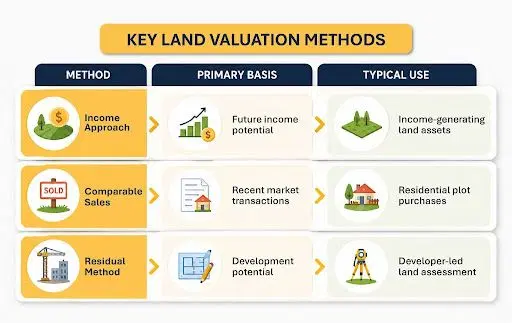
Income Approach: When Future Earnings Matter
The income approach estimates land value based on the income-generating potential of the asset.
This method becomes increasingly relevant for plots located in destinations with:
- Hospitality potential
- Commercial development demand
- Rental-led development opportunities
Under this framework, future income expectations are analysed and translated into present-day value.
For investors assessing land investment opportunities in high-growth destinations, the income approach helps connect price to economic productivity rather than only surrounding transactions.
Comparable Sales Method: The Most Common Approach
Under this framework, the subject parcel is benchmarked against recent transactions involving comparable plots in the same micro-market. Adjustments are then made to account for differences in:
- Branded vs non-branded developments
- Size
- Accessibility
- Road frontage
- Legal status
- Location quality within the locality
For buyers trying to understand how to purchase a plot of land intelligently, this is often the most practical valuation framework because it directly relates market evidence to the parcel under consideration.
This method is particularly useful where sufficient recent transaction data exists.
Residual Method: How Developers Assess Land
The residual method is commonly used by developers and sophisticated investors.
It works backwards from the projected value of a completed development and deducts estimated development costs, financing costs, approval costs, and profit margins. The balance indicates what the land beneath that project is worth today.
This method becomes particularly useful when assessing whether an asking price is supported by actual development potential.
For buyers considering larger-format parcels or strategic buy plot opportunities, the residual method provides a disciplined way to stress-test the investment thesis.
Why Valuation Matters Before Purchase and During Exit
Understanding land valuation and long-term investment value before purchase and exit offers several practical advantages.
- A benchmark for acquisition pricing
- A reference point for monitoring appreciation during the holding period
- Greater confidence when negotiating resale value
- Stronger documentation when leveraging the asset
Without valuation discipline, price discussions often become driven by perception rather than evidence.
Why Structured Developments Support Better Valuation Outcomes
In fragmented land markets, valuation can become more complex where title chains, infrastructure, or access remain uncertain.
- Structured developments simplify this process through:
- Clear legal ownership frameworks
- Planned infrastructure
- Better-defined location positioning
- Greater transaction comparability
Developers like The House of Abhinandan Lodha® operate within this framework, helping create stronger valuation benchmarks and clearer market reference points.
Conclusion
Land valuation brings structure, evidence, and financial clarity to land transactions. Understanding the valuation method being applied helps investors interpret quoted prices more accurately, assess whether a premium is justified, and make decisions with greater confidence.
For HNIs and NRIs, this becomes particularly valuable across the full investment lifecycle (from purchase and holding to resale or leverage). When valuation is grounded in market evidence, legal clarity, and development potential, land becomes not only a physical asset but a financially legible one.
Projects by The House of Abhinandan Lodha® are positioned within this framework through planned infrastructure, strong title discipline, and location-led growth, helping create a more reliable basis for long-term value creation.
FAQs
Q1. What is land valuation?
Land valuation is the professional process of determining the financial worth of land based on legal, physical, and market factors.
Q2. What is the market valuation of land?
The market valuation of land is the estimated price a plot can command under prevailing market conditions.
Q3. What is a land valuation certificate?
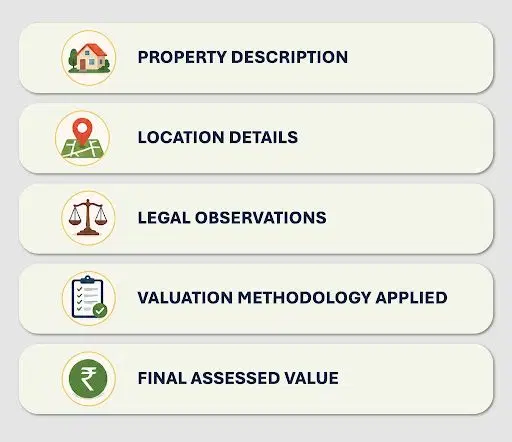
A land valuation certificate is a formal document prepared by a qualified valuer that records the methodology and assessed value of a plot.
Q4. How to check the valuation of land?
It usually involves reviewing comparable transactions, circle rates, location factors, and professional valuation reports.
Q5. How to purchase a plot of land more confidently?
Understanding pricing benchmarks, title clarity, infrastructure context, and valuation methodology can support better decision-making.